Views: 0 Author: Site Editor Publish Time: 2026-07-23 Origin: Site
Improper fastening in commercial environments carries massive operational risks. A single sheared fastener can trigger sudden machinery downtime, cause catastrophic pallet rack collapse, or lead to severe workplace injury. You cannot treat the selection of these fasteners as a simple commodity purchase. It represents a critical engineering and compliance decision impacting your entire facility.
We designed this guide to provide a strictly objective, criteria-based framework. You will learn how to properly evaluate, specify, and source the correct industrial components for high-load applications. By understanding the mechanical differences between various locking mechanisms, you can secure your equipment efficiently while maintaining regulatory compliance.
Application dictates the mechanism: Static loads (like pallet racking) require different locking mechanisms than dynamic, high-vibration environments (like aerospace or heavy machinery).
Material choice prevents failure: Selecting the right alloy (e.g., 300 vs. 400 series stainless steel) is mandatory to resist shear forces and environmental corrosion.
Ergonomics impact compliance: Choosing the right handle type and lanyard configuration directly reduces operator fatigue and prevents lost components.
Customization is often necessary: Standard catalog dimensions do not always meet specialized OEM or tooling requirements.
Industrial facility managers must evaluate Safety Pins against three primary success criteria. You need to maximize shear strength, ensure positive locking, and maintain rapid operational workflow. Finding the right balance prevents catastrophic accidents while keeping production lines moving smoothly.
The operational liability of using inadequate standard fasteners is immense. High-vibration applications present a unique challenge. Constant machine oscillation forces basic friction-fit fasteners to walk backward out of their alignment holes. Accidental back-out immediately creates an unprotected shear plane. When heavy equipment shifts unexpectedly, the resulting damage compromises employee safety and destroys expensive inventory.
You must establish a rigorous baseline evaluation framework. First, determine the maximum load capacity required. Focus primarily on shear forces (perpendicular stress) rather than tensile forces (pulling stress). Next, evaluate the environmental exposure your equipment faces daily. Finally, calculate the frequency of engagement and disengagement. Operators who remove fasteners dozens of times a shift need highly ergonomic solutions to prevent fatigue and bypass behaviors.
Best Practice: Always document your load requirements before contacting suppliers. Knowing your exact shear stress numbers ensures you procure a component rated for your specific industrial environment.
Standard industrial fasteners serve an important, albeit limited, purpose. Basic wire lock mechanisms, J-pins, and drop fasteners work adequately in static commercial applications. Warehouse pallet racking rarely experiences dynamic oscillation. In these static environments, gravity or simple wire loops provide enough resistance to keep the fastener seated properly.
However, modern manufacturing and heavy machinery require an immediate upgrade to precision. You should implement the quick release ball lock pin as the standard for high-security, high-frequency applications. These precision components eliminate the guesswork associated with friction-fit alternatives.
The internal mechanism guarantees verifiable, fail-safe engagement. A central spring-loaded spindle runs through the core of the shaft. When pushed, the spindle retracts, allowing small detent balls to drop inside the shaft body. Once the operator releases the button, the spindle drives the balls outward. They lock rigidly against the outer edge of the drilled hole. Radial vibration cannot overcome this mechanical lock. The component remains absolutely secure until an operator intentionally depresses the actuator button.
You must carefully analyze the operational environment before specifying an alloy. Temperature extremes degrade weak metals rapidly. Chemical exposure in processing plants induces localized pitting. High moisture levels in marine applications lead to rapid oxidation. A poor material choice inevitably results in sudden shear failure under load.
Carbon steel provides excellent initial yield strength. However, it requires zinc plating to prevent rust. Once this plating scratches during normal operation, corrosion begins instantly. Rust weakens the shaft and seizes the internal spindle mechanism. Therefore, you must specify stainless steel ball lock pins in marine, food processing, and medical environments.
Understanding specific metallurgical realities helps you make better decisions. You generally choose between two common alloy families. The 300-series (such as 304 or 316) offers superior corrosion resistance. It withstands harsh washdown chemicals easily. However, it lacks the ultimate shear strength of harder alloys.
When your application demands immense shear resistance alongside durability, choose a 400-series or a 17-4 PH quick release ball lock pin stainless steel. Manufacturers heat-treat 17-4 precipitation-hardened (PH) steel to achieve massive load capacities. It bridges the gap perfectly between environmental resistance and heavy-duty mechanical strength.
Common Mistake: Do not specify 316-grade alloys for high-shear load-bearing joints just because they resist corrosion well. Always verify the yield strength matches your physical load requirements.
Alloy Type | Primary Advantage | Corrosion Resistance | Shear Strength Rating |
|---|---|---|---|
Carbon Steel (Plated) | High initial strength, economical | Low (once scratched) | Very High |
300-Series Stainless | Excellent chemical resistance | Very High | Moderate |
17-4 PH Stainless | Optimal balance of strength/durability | High | Very High |
Handle selection dictates operator safety, clearance constraints, and daily cycle times. Engineers often overlook the handle profile, focusing entirely on shaft diameter. Yet, a poorly chosen handle slows down production and frustrates workers.
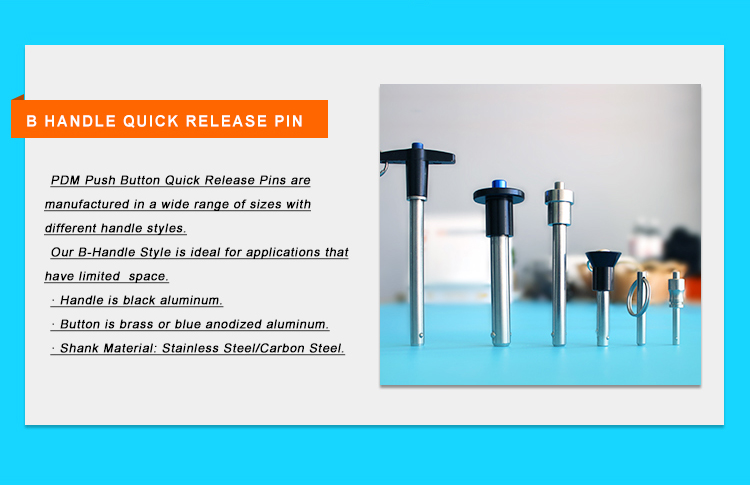
You must contrast the most common configurations available today. L-handles provide an asymmetrical grip useful for twisting and pulling simultaneously. Ring handles take up the least space, making them ideal for exceptionally tight clearances. However, ring variations offer very little leverage for stubborn alignments.
You should specifically mandate a handle quick release ball lock pin when operators face specific ergonomic challenges. Use broad T-handles whenever high grip force requirements exist. Workers wearing heavy industrial gloves can easily wrap their fingers around a T-handle to disengage the spindle. Conversely, specify low-profile button handles for tooling fixtures where moving machine parts might snag a protruding T-handle.
Configuration | Best Operator Scenario | Spatial Clearance Needed |
|---|---|---|
T-Profile | Heavy gloves, high extraction force | Large |
L-Profile | Awkward angles, rotational pulling | Medium |
Button/Dome | Rapid assembly, automated fixtures | Minimal |
Ring Pull | Confined spaces, occasional use | Very Minimal |
Lost or misplaced components routinely halt production lines. When an operator removes a fastener and sets it down, vibration or simple forgetfulness can cause it to vanish. Finding a suitable replacement wastes valuable time. Substituting an unrated bolt compromises the entire safety framework.
You must introduce the quick release ball lock pin with lanyard as your standard preventative solution. Tethering the fastener directly to the machinery eliminates the risk of loss completely.
Evaluate your tethering options carefully based on the surrounding environment:
Bare Wire Rope: Provides high tensile strength but can fray and scratch painted surfaces over time.
Nylon-Coated Cables: Offers excellent protection against abrasion. The coating prevents damage to sensitive aerospace or medical equipment.
Metal Chain Varieties: Highly resistant to extreme temperatures and welding spatter, though they pose higher snag risks in dense mechanical areas.
Installation best practices dictate securing the lanyard securely to the primary structure. You must ensure the tether length allows a full operational range. If the tether stretches too tightly, operators cannot align the shaft properly. If it hangs too loosely, the cable might tangle in moving belts or gears.
Off-the-shelf fasteners have definitive limits. Catalog dimensions rarely account for highly specific OEM tooling needs. You might encounter non-standard grip lengths, highly specialized shear load minimums, or demands for proprietary handle materials.
When standard catalogs fail your engineering review, you must engage a manufacturer for a custom ball lock pin. Doing so guarantees the component matches your unique mechanical drawings perfectly. Relying on makeshift spacers or oversized holes creates dangerous failure points.
To successfully solicit an accurate RFQ from a manufacturer, you must detail exact specifications. Follow this specific sequence when drafting your requirements:
Define the Grip Length: Measure the exact distance from beneath the handle collar to the top of the locking balls. This ensures the balls deploy completely outside the joint.
Specify Pin Diameter and Tolerances: Provide the exact shaft diameter needed. Include the required positive and negative decimal tolerances to ensure a snug fit without binding.
Determine Shear Strength (lbs/kN): State your minimum required breaking point in double-shear testing configurations.
Select Material and Actuation: Name the exact steel alloy and handle profile required.
Require Specialized Finishes: Note any necessary secondary processes. Ask for passivation to remove free iron, or black oxide coating for reduced glare in optical environments.
Choosing the correct industrial fastener requires a methodical approach. You must systematically match the internal mechanism to your vibration risks. Align the material alloy to your facility's environmental exposure. Finally, fit the handle configuration and tethering system directly to your operator's ergonomic needs.
We advise buyers to strictly prioritize manufacturers providing transparent shear-strength testing data. Reputable suppliers willingly share material certifications and factory test results. Avoid the temptation of lowest-cost suppliers who cannot verify their metallurgical quality.
Take immediate action today. Conduct an internal safety audit of your current load-bearing joints. Identify any standard friction fasteners currently deployed in high-vibration areas. If you uncover potential risks, contact an application engineer immediately to discuss your specific load requirements and upgrade your hardware.
A: You determine shear strength by calculating the maximum lateral force applied across the shaft. Engineers evaluate this using single shear (stress across one plane) or double shear (stress across two planes). Double shear essentially doubles the load capacity. Always request factory testing data from the manufacturer to ensure the component exceeds your calculated maximum force by a safe margin.
A: Single-acting mechanisms require the operator to press a push-button to release the locking detent balls. Double-acting mechanisms offer a push-or-pull release function. This dual-action design provides faster extraction capabilities and operates reliably in extreme high-speed applications where operators must forcefully yank the fastener out of alignment.
A: OSHA broadly mandates secure load-bearing practices to protect workers, but they rarely specify fastener designs. Instead, you must look to targeted industry standards. Engineers typically rely on ASME guidelines for general industrial use, or NASM (National Aerospace Standards) specifications for highly regulated aviation and military applications.
A: Lead times vary significantly based on design complexity. Typical projects range from a few weeks to several months. The timeline includes initial CAD design approval, custom tooling setup, machining, secondary heat treatments, and rigorous shear strength testing. Always factor these realistic expectations into your project schedule.