Views: 0 Author: Site Editor Publish Time: 2026-06-16 Origin: Site
Securing components to soft shafts poses a distinct engineering challenge. You must achieve a strong grip under continuous vibration without marring the mating surface. Traditional metal fasteners often permanently deform aluminum or plastic shafts during tightening. This deformation ruins precision assemblies. It causes misalignment and forces technicians to discard expensive mechanical components during routine teardowns.
This guide serves as a comprehensive technical resource. It helps design engineers and procurement professionals evaluate polymer-tipped fasteners against standard metal points. We will examine the core mechanics behind these specialized components. You will discover how they solve aggressive surface galling while acting as localized vibration dampers.
However, specifying these components requires careful consideration of physical boundaries. We will set an evidence-oriented baseline. You will learn how these fasteners introduce new design constraints regarding maximum seating torque, continuous operating temperatures, and shear limits. By understanding these exact limitations, you can properly factor them into your final assembly specifications.
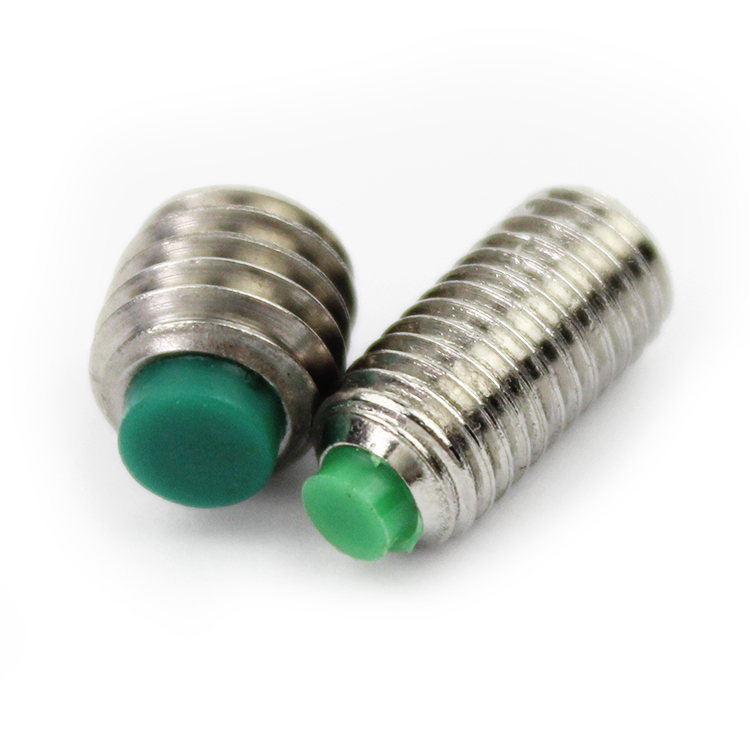
Nylon tip set screws prevent galling and indentation on soft shafts (aluminum, brass, plastics) while providing a compressible, vibration-resistant lock.
Specifying the right component requires matching the fastener body material (Alloy Steel vs. Stainless Steel) to the environmental conditions, separate from the tip material.
Standard sizes range from M2 to M10 (Metric) and #2-56 to 3/8" (Imperial), but non-standard configurations often carry high MOQs and longer lead times.
Maximum continuous operating temperatures for standard Nylon 6/6 tips rarely exceed 250°F (120°C), making them unsuitable for high-heat industrial applications.
Engineers must account for lower maximum seating torque compared to hardened steel cup-point screws to prevent tip extrusion or shearing.
Engineers traditionally rely on cup, cone, or flat point set screws for power transmission. These hardened metal points achieve their holding power through penetration. They bite directly into the mating shaft. While effective for torque transfer, this mechanical biting creates permanent surface deformation. When technicians attempt to adjust or disassemble the mechanism, the raised burrs from the initial bite cause immediate failure. Collars bind against the damaged shaft. Precision linear guides jam. Replacing a simple pulley often escalates into a complete shaft replacement because the mating surface lost its structural integrity.
To eliminate this destructive metal-to-metal penetration, engineers deploy nylon tip set screws. These components utilize a compressive polymer insert seated within the hollowed tip of the metal body. When you apply seating torque, the nylon insert compresses against the shaft. It conforms exactly to the microscopic topography of the mating surface. This conformal action generates immense friction without breaking the surface plane. You effectively secure the component purely through radial pressure and material friction.
The compressive nature of the polymer yields a crucial secondary benefit. The insert acts as a localized vibration damper. High-frequency micro-vibrations routinely back out traditional steel threads. The compressed nylon pushes back against the internal threads, creating a constant prevailing torque. It acts similarly to a mechanical thread locker. Furthermore, because you avoid metal yielding, you can repeatedly loosen, adjust, and retighten the assembly. The polymer maintains sufficient memory for multiple adjustment cycles without degrading the underlying thread path.
Despite their advantages, you must transparently acknowledge their structural limitations. Polymer tips offer significantly less holding power than hardened steel points. They handle much lower axial loads and torsional load capacities. If your application involves high-shock rotational forces, a polymer insert alone cannot prevent slipping. You must rely on physical keyways or splines for heavy power transmission, utilizing the polymer tip merely for axial retention.
Specifying the correct fastener requires treating it as a two-part system. You must independently evaluate the outer metal body and the inner polymer tip to match your environmental conditions.
Alloy Steel (Black Oxide): You should select alloy steel for high-strength requirements in highly controlled environments. This material boasts superior hardness ratings. It allows for higher internal wrenching torque before stripping the drive recess. However, it remains highly susceptible to ambient moisture and corrosion.
Stainless Steel (18-8, 304, 316): You need stainless steel for medical, marine, or food-grade applications. It resists rust and chemical washdowns. Note the inherent trade-off. Austenitic stainless steel yields a lower tensile strength compared to heat-treated alloy steel. You must reduce your applied seating torque accordingly.
The tip material dictates the actual interface behavior. Nylon 6/6 serves as the industry standard. It delivers an optimal balance of compressive strength and elasticity. It easily resists standard petroleum-based lubricants, machine oils, and common solvents. However, Nylon 6/6 absorbs ambient moisture over time, which can slightly alter its dimensional tolerances in highly humid environments.
Sometimes you need to look beyond standard nylon. Buyers might step up to alternative inserts based on extreme operational conditions. Brass tips offer an excellent intermediate step. They remain softer than steel shafts but handle higher torque than plastics. Delrin (Acetal) absorbs practically zero moisture, making it ideal for submerged applications. PEEK delivers ultimate chemical resistance and survives in environments where lesser polymers quickly degrade.
You must define the exact failure modes of these polymers under extreme conditions. Standard nylon melts or severely degrades when exposed to continuous heat exceeding 250°F (120°C). If you push the temperature higher, the polymer loses its compressive modulus. It extrudes out of the thread gap, instantly eliminating all holding power. Likewise, exposing standard nylon to strong acids or concentrated phenols causes rapid embrittlement. You must map your chemical exposure before writing the final specification.
Insert Material | Max Continuous Temp | Moisture Absorption | Relative Compressive Strength | Primary Use Case |
|---|---|---|---|---|
Nylon 6/6 | 250°F (120°C) | High (Up to 8.5%) | Moderate | General no-mar locking |
Delrin (Acetal) | 185°F (85°C) | Very Low (<0.5%) | High | High-humidity environments |
PEEK | 480°F (250°C) | Extremely Low | Very High | Extreme heat or chemical zones |
Brass | 400°F+ (204°C+) | None | Maximum | Heavy loads on steel shafts |
Fastener dimensions fall into two primary standards: Metric and Unified National. Metric sizes generally conform to ISO or DIN equivalents, typically ranging from M2 for micro-assemblies up to M10 for industrial clamps. Imperial sizes (UNC/UNF) commonly span from #2-56 up to 3/8".
Measuring the total length requires absolute precision. Follow these steps to ensure correct fitment:
Measure the rigid metal body length from the flat top to the base of the metal threads.
Measure the exposed portion of the uncompressed polymer tip.
Combine these two values for the nominal overall length.
Calculate the compressed length. The nylon tip typically compresses by 30% to 50% during final seating. You must ensure the metal body does not protrude beyond your collar once fully tightened.
You must select the correct drive type for your torque requirements. The socket (hex) drive remains the undisputed standard for industrial applications. It accommodates a hex key, allowing you to transfer high seating torque safely without stripping the recess. Conversely, slotted drives serve specific low-profile needs. They work well for miniature assemblies where space limitations prevent hex key access, though they strictly limit the amount of torque you can apply.
When evaluating suppliers, you must reference exact manufacturing standards. Specifying DIN 913 or ISO 4026 base standards ensures consistent thread engagement. These standards dictate the pitch diameter, thread angle, and overall concentricity of the metal body. Strict adherence prevents cross-threading and ensures the polymer tip remains securely swaged into the metal cavity during aggressive vibration cycles.
Certain industries heavily rely on nylon tip set screws due to strict surface integrity requirements. Standard fasteners simply fail to meet the operational criteria in these fields.
Optical assemblies demand absolute precision. You use these fasteners to secure delicate lenses, finely tuned mirrors, and sensitive adjustment knobs. Even microscopic marring on a guide rail disrupts laser calibration. The polymer tip provides firm retention while allowing engineers to perform micro-adjustments during complex optical alignments.
Surgical robotics and diagnostic imaging machines require strict cleanliness. If a standard steel screw galls an aluminum rail, it generates microscopic metal flakes. These flakes contaminate sterile fields and ruin linear bearings. The soft polymer tip eliminates particulate generation. It also survives the repeated calibration cycles necessary for maintaining robotic arm precision.
In pneumatic manifolds, the polymer insert serves a crucial dual purpose. It locks the adjustment valve in place, but it also creates a localized mechanical seal. The compressed nylon presses into the internal thread roots, actively preventing high-pressure gas or fluid creep along the spiral thread path.
Industry | Primary Benefit | Typical Fastener Spec | Common Risk Factor |
|---|---|---|---|
Optics | Eliminates micro-marring | Stainless Steel / Nylon | Over-torquing distorting rails |
Medical | Prevents metal flaking | 316 Stainless / PEEK | Chemical washdown degradation |
Pneumatics | Thread sealing / Locking | Alloy Steel / Nylon | Pressure bypassing threads |
You cannot swap a metal point for a polymer point at a 1:1 ratio. You must manually calculate if the reduced holding power meets your assembly's dynamic load. Determine your required axial retention force. If the necessary seating torque to achieve this force exceeds the polymer's crush rating, you face immediate failure. In high-torque power transmission scenarios, you should pivot away from friction-based locking. Instead, use a flat or dog point set screw seated securely into a machined shaft keyway.
Poor installation practices destroy polymer-tipped fasteners. You must enforce strict guidance on seating torque limits on the assembly line. Applying excessive rotational force causes "mushrooming." The polymer violently extrudes out of the thread gap, destroying the internal cavity. Alternatively, the tip simply shears off entirely. Always publish clear torque maximums for your technicians.
Additionally, monitor your mating tolerances. If the gap between the collar and the shaft remains too wide, the polymer tip will bulge into the void rather than compressing flatly against the target surface. Keep tolerances tight to direct all compressive force straight downward.
When routing your bill of materials, you must differentiate between standard and custom configurations. Standard catalog sizes ship quickly and keep production lines moving. However, if your design requires extreme thread-to-tip length ratios, you enter custom territory. Sourcing specialized tip set screws often carries high Minimum Order Quantities (MOQs). You will face extended prototyping delays and longer overall lead times.
Perform thorough vendor auditing before placing bulk orders. Look for suppliers who provide clear, published torque spec sheets. Demand verifiable material certifications to confirm the exact polymer grade. Lastly, ensure they maintain strict lot traceability in case a specific batch exhibits premature tip shearing in the field.
Selecting the right fastener demands a careful balance. You must prevent surface damage while maintaining sufficient holding power to survive operational vibration. Polymer tips solve the marring problem brilliantly, provided you respect their structural limitations.
Before committing to a bulk B2B procurement contract, take clear action. First, audit your machine's continuous operating temperatures to rule out premature melting. Next, calculate your required seating torque and verify it falls below the polymer's extrusion threshold. Finally, request sample batches. Perform physical assembly testing to validate the compressive memory and holding force under actual dynamic loads. This evidence-based approach ensures your precision assemblies remain secure and pristine.
A: Yes, they offer excellent reusability for micro-adjustments. The polymer exhibits strong compression memory, allowing it to spring back after loosening. However, this memory has a finite lifespan. If you subject the fastener to full torque cycles repeatedly, the insert eventually flattens and loses its elasticity.
A: Standard Nylon 6/6 inserts handle continuous operating temperatures up to 250°F (121°C). If your application exceeds this threshold, the polymer will soften and fail. For higher temperatures, you must upgrade your specification to PEEK or solid brass inserts.
A: Manufacturers measure the overall nominal length by including the extended, uncompressed nylon tip. However, variances exist across different brands regarding the exact tip protrusion length. Always consult the supplier's dimensional drawings to account for the compressed length during final assembly.
A: No. The compressed polymer pushes radially against the internal threads, providing significant prevailing torque. Adding liquid threadlockers is redundant. Furthermore, certain anaerobic chemicals in liquid threadlockers can react poorly with specific polymer inserts, causing premature embrittlement.