Views: 0 Author: Site Editor Publish Time: 2026-09-30 Origin: Site
Fasteners hold modern mechanical infrastructure together. A single sheared bolt can trigger catastrophic breakdowns. It halts assembly lines and inflates project budgets beyond repair. Choosing the wrong hardware is not merely a procurement error. It is a fundamental safety risk.
In tight spatial constraints, traditional hex heads often fail to provide the necessary clearance. This is where the socket cap screw steps in. Engineered with an internal hexagonal drive, it handles high-torque, clearance-restricted applications effortlessly. By understanding the metallurgical realities behind different fastener grades, engineers and procurement teams can eliminate guesswork.
This comprehensive guide breaks down the structural limits and ideal use cases for various fastener classes. It empowers you to make data-driven, cost-effective purchasing decisions.
Maximum Clamping Force: Class 12.9 fasteners offer the highest commercially available tensile strength at 1200 MPa. They are engineered specifically for extreme heavy-duty static loads.
The Rugged Standard: Class 10.9 provides an optimal balance of structural rigidity at 1040 MPa and impact resistance. This makes it the go-to choice for automotive and dynamic machinery.
Environmental Endurance: Stainless steel variants prioritize corrosion resistance over raw mechanical tension. They act as essential components in marine, food-grade, or outdoor environments.
Strategic Sourcing: Selecting the correct hardware requires a calculated balance. You must weigh required yield strength against chemical exposure risks and overall project budget.
Moving beyond basic hardware, standard external-wrenching bolts frequently fall short in advanced manufacturing. Socket cap screws fill this engineering void. Characterized by their smooth cylindrical heads and internal hex drives, they do not require lateral space for a wrench to rotate. Mechanics drive them directly from the center using an Allen key or hex bit. This distinct geometric profile offers several mechanical advantages.
Clearance is a luxury in complex machinery. Traditional hardware demands significant room for tooling. The internal drive mechanism eliminates this lateral space requirement. Mechanics can install fasteners deep within recessed cavities. Furthermore, the cylindrical head is perfectly suited for counter-boring. The head can sit entirely flush with the mating surface, or even below it. This creates a smooth exterior profile that prevents interference with moving belts or pulleys. It also improves the aerodynamic qualities of the final assembly.
Applying rotational force to a standard Phillips screw often pushes the tool outward. This frustrating phenomenon is known as cam-out. It strips the head and limits clamping force. The vertical walls of an internal hex drive ensure direct torque transfer into rotational movement. Automated assembly robots and technicians can apply significantly higher torque specs without damaging the component. This generates the massive clamping forces required for rigid structural joints.
Due to their formidable strength and low-profile design, these components are heavily relied upon across demanding sectors. In the aerospace industry, they secure critical turbine housings where every millimeter matters. Mechanics working deep inside oily automotive engine blocks rely on them for transmission assemblies. Injection molding dies and precision tooling also utilize these compact powerhouses to maintain structural rigidity under immense, repetitive operational stress.
To make informed decisions, we must look at the numbers. Before purchasing hardware based purely on thread pitch and length, decision-makers must understand specific metallurgical metrics. Evaluating a joint without knowing its mechanical ceiling is a recipe for disaster.
Ultimate Tensile Strength represents the absolute maximum tension a component can withstand before it physically fractures. Measured in Megapascals for metric hardware, it is the absolute ceiling of structural integrity. A high ultimate tensile strength indicates a formidable piece of metal. However, engineers rarely design joints to operate near this limit. Doing so leaves zero safety margin for unexpected dynamic jolts.
For practical daily operations, Yield Strength is the far more critical metric. It defines the maximum load a piece of hardware can endure before undergoing plastic deformation. Think of a bolt as a highly rigid spring. When tightened, it stretches elastically. It will return to its original length if loosened. If tension exceeds the yield point, the metal stretches permanently. A yielded bolt instantly loses its clamping force. This leads to severe vibration, loose joints, and eventual mechanical failure.
The International Organization for Standardization utilizes a property class system to clearly communicate these limits. The system uses two numbers separated by a decimal point, like 10.9. The formula is remarkably straightforward.
The First Number: Represents the nominal ultimate tensile strength. Multiply this digit by 100 to find the total value. For a class 10.9, 10 times 100 equals 1000 MPa.
The Second Number: Represents the yield strength as a percentage of the tensile limit. Multiply it by 10. The 9 indicates the yield point is 90 percent of the tensile strength. Therefore, 90 percent of 1000 MPa gives a nominal yield strength of 900 MPa.
Picture a massive hydraulic stamping press coming down with tons of force. When an engineering schematic demands the absolute highest level of clamping force available, grade 12.9 socket head bolts are the definitive choice. They represent the apex of commercial high-strength fastening technology.
Forged from premium alloy steels containing chromium, molybdenum, and vanadium, these fasteners undergo rigorous heat treatment. They are heated to extreme temperatures, rapidly quenched in oil to create a highly hard structure, and finally tempered to restore a calculated amount of toughness. Based on ISO 898-1 testing standards, their mechanical limits are exceptional. They offer a minimum tensile strength of 1220 MPa and a yield point of 1100 MPa. High-end industrial variants feature precise thread pitches ranging from M1.6 to M64, accommodating everything from micro-assemblies to massive structural frames.
Consequently, they are reserved for critical heavy-duty applications. Earth-moving equipment, hydraulic cylinders, and high-performance engine internals rely on them. However, extreme hardness introduces a critical trade-off. They are brittle. If pushed past their limit, they tend to snap suddenly. Their high hardness also makes them susceptible to hydrogen embrittlement. Electroplating them with zinc requires a strict post-baking outgassing procedure. Otherwise, trapped atomic hydrogen causes microscopic cracks, leading to unpredictable failure under minimal loads.
While the 12.9 class offers maximum raw power, grade 10.9 socket head bolts are widely recognized as the most versatile heavy-duty option in the manufacturing sector. They deliver an exceptional balance of high tensile capacity, ductility, and cost-effectiveness.
Manufactured from medium carbon alloy steel or low carbon boron steel, they undergo quenching and tempering to align their crystalline structure. The resulting specifications dictate a minimum tensile strength of 1040 MPa and a yield strength of 940 MPa.
Engineers frequently specify this class over stronger alternatives specifically because of its ductility. The slightly lower hardness grants the metal a higher capacity to absorb dynamic shock loads without fracturing. In an automotive suspension system experiencing sudden jolts from rough terrain, an overly rigid piece of metal might snap. The 10.9 alloy absorbs the kinetic energy. It stretches marginally within its elastic limit and maintains chassis integrity. Furthermore, they are far less susceptible to hydrogen embrittlement. This makes them safer and easier to zinc-plate for rust prevention.
Looking at the broader manufacturing landscape, the global fastening sector is currently undergoing a massive transformation. The automotive and aerospace industries are heavily influencing a pivot toward lightweighting. As electric vehicle manufacturing scales up, engineers are actively moving away from bulky traditional hardware. There is a surging demand for compact, high-tensile components. These advanced fasteners reduce the overall weight of battery enclosures and chassis assemblies without compromising crash safety.
Recent market analyses indicate a strong upward trend in the adoption of advanced alloy treatments and specialized non-electrolytic anti-corrosion coatings. Zinc-flake coatings are becoming the new standard. These innovations allow high-grade fasteners to perform reliably in harsh high-voltage environments while mitigating the risks of hydrogen embrittlement. This industry-wide shift underscores why precise grade selection is a core component of modern mechanical design.
When operating environments involve continuous moisture, harsh cleaning chemicals, or coastal weather, even zinc-plated alloy steel will eventually succumb to rust. In these scenarios, procurement teams must pivot to stainless steel socket head screws.
It is vital to shatter a widespread industry misconception. Stainless steel is not stronger than high-grade alloy steel. From a purely load-bearing perspective, it is significantly weaker. Its primary function is to prioritize environmental endurance over extreme mechanical tension.
These variants are categorized by their austenitic alloy composition rather than the standard property class system:
A2 Stainless Steel: Also known as 304, this alloy contains approximately 18 percent chromium and 8 percent nickel. The chromium reacts with oxygen to form a microscopic self-healing passive layer that prevents rust. A2 is perfect for general outdoor infrastructure, wet environments, and food processing machinery where hygiene is paramount.
A4 Stainless Steel: For more aggressive environments, A4 is mandatory. Incorporating 2 to 3 percent molybdenum drastically increases resistance to chloride attack. A4 is the undisputed standard for marine engineering, offshore oil rigs, and chemical processing plants.
Mechanically, they typically fall under Class 70 or 80. A Class 80 stainless piece offers a nominal tensile strength of 800 MPa and a yield limit of 600 MPa. Replacing a structural 10.9 alloy component with a stainless variant without recalculating the joint load capacity is a dangerous practice. It frequently results in shear failure.
To assist procurement teams in making rapid, data-driven decisions, the following matrix directly compares the mechanical and environmental properties of the discussed fastener classes.
Fastener Grade | Material Type | Nominal Tensile Strength MPa | Nominal Yield Strength MPa | Corrosion Resistance Level | Primary Industry Application |
|---|---|---|---|---|---|
Grade 12.9 | Quenched & Tempered Alloy Steel | 1200 - 1220 | 1080 - 1100 | Low - Requires oil or specialized coating | Heavy machinery, stamping presses, static high-tension joints |
Grade 10.9 | Medium Carbon Alloy Steel | 1040 | 940 | Low to Medium - Can be safely zinc-plated | Automotive suspensions, commercial vehicle frames, dynamic loads |
Stainless A2-70 | 304 Austenitic Stainless Steel | 700 | 450 | High - General rust prevention | Food processing, outdoor infrastructure, general wet environments |
Stainless A4-80 | 316 Austenitic Stainless Steel | 800 | 600 | Extreme - Chloride and Salt resistant | Marine engineering, chemical plants, offshore platforms |
Data is only useful when applied correctly. Understanding metallurgical data is merely the first phase. Applying that data to real-world design requires a systematic approach. Utilize the following decision matrix to eliminate guesswork.
The primary function of any joint is to maintain clamping force under operational stress. Identify the primary forces at play. Are you dealing with tension, shear, or cyclic fatigue? If the assembly holds massive static weight to prevent heavy steel plates from sliding, class 12.9 is required. Conversely, if the joint will experience dynamic transverse forces or sudden impacts, the higher ductility of class 10.9 makes it the more resilient choice.
Mechanical rigidity is irrelevant if the metal rusts away in six months. Evaluate the operating environment meticulously. If the component is internal and bathed in engine oil, a black-oxide alloy is perfectly safe. If exposed to normal weather, zinc-plating is standard. However, if the application involves submersion in saltwater or strict sanitary washdowns, you must sacrifice raw tensile strength and specify A2 or A4 austenitic alloys.
Procurement professionals must balance technical requirements with the total cost of ownership. Over-engineering every connection inflates manufacturing costs unnecessarily. If a joint calculations show that a 10.9 provides an ample safety margin, upgrading to a premium 12.9 is a waste of budget. Similarly, for non-critical covers or access panels, sourcing reliable standard fasteners optimizes the supply chain without compromising structural safety.
A high-strength component is only as secure as the material it threads into. Torquing a 12.9 piece into a soft aluminum engine block will instantly strip the internal threads. Ensure the tapped hole or accompanying nut is mechanically compatible with the bolt strength class. In scenarios where vibration loosening is a persistent issue, engineers integrate nylon tip socket cap screws. These provide extra prevailing torque, ensuring the assembly remains locked tight under cyclic fatigue.
Choosing the correct hardware is a calculated engineering decision. It directly impacts the safety and longevity of your machinery. While class 12.9 reigns supreme in pure static clamping force, class 10.9 offers the rugged versatility needed for dynamic daily use. Meanwhile, austenitic alloys stand as the undisputed champions of environmental endurance.
Never rely on assumptions when it comes to structural integrity. Always match the metallurgical profile to your project specific mechanical and environmental demands. Consult your engineering schematics, review your technical specifications, and source high-quality components to ensure your next build operates flawlessly.
Ready to upgrade your assembly line with industrial-grade fastening solutions? Head over to PDM Industry to explore a comprehensive catalog of high-performance socket head bolts, custom stainless variants, and engineered standard fasteners tailored for your most demanding projects. Secure your infrastructure with precision today.
Generally, upgrading to a stronger component is mechanically safe, but it is not a simple plug-and-play swap. Because the 12.9 class possesses a higher yield point, it requires a significantly higher installation torque to achieve the correct preload. If installed using the torque specifications meant for a 10.9, the joint will be under-clamped, leading to vibration loosening and fatigue failure. Additionally, in applications specifically designed to utilize the ductility of a 10.9 to absorb shock, the harder 12.9 might prove too brittle, causing a sudden fracture under heavy impact.
Categorically, no. This is a highly dangerous misconception. Automotive suspensions are subjected to extreme dynamic loads, high shear forces, and constant vibration. These applications universally require the high tensile and yield limits provided by 10.9 or 12.9 alloy steel. Standard A2 or A4 alloys have a yield strength of roughly 450 to 600 MPa, which is less than half the strength of a 10.9. Using them in a high-stress suspension joint will almost certainly result in the metal stretching, permanently deforming, or shearing off entirely.
International standards dictate strict marking requirements for metric hardware to ensure traceability. You can identify the class by examining the top of the cylindrical head or the side of the knurled edge. High-strength metric alloy pieces will have the numbers 10.9 or 12.9 clearly stamped or forged into the metal. For austenitic alloys, the markings will typically feature alphanumeric codes such as A2-70 or A4-80. If a piece lacks any identifying marks, it should never be used in a structural or load-bearing application.
Yes, in the vast majority of mechanical applications, hardened washers are highly recommended. The design features a cylindrical head with a relatively small under-head bearing surface compared to a standard hex head. When high torque is applied to achieve the necessary preload, this small surface area concentrates the compressive force. Without a washer to distribute this load, the head can embed itself into softer mating materials such as aluminum or mild steel, causing an immediate loss of tension and a loose joint.
If you are working with inch-based measurements and need a strength profile comparable to a metric 10.9, the closest standard equivalent is an SAE Grade 8 bolt. SAE Grade 8 hardware is manufactured from medium carbon alloy steel and tempered to achieve a minimum tensile strength of 150,000 psi or roughly 1034 MPa, aligning almost perfectly with the 1040 MPa specification. However, imperial socket cap screws are typically governed by the ASTM A574 standard, which dictates a tensile limit closer to 170,000 psi, making them slightly stronger than a metric 10.9.
Galling and seizing are common issues when fasteners are exposed to extreme heat, particularly with stainless steel variants. To prevent this, engineers apply specialized anti-seize compounds containing copper, nickel, or graphite before installation. These lubricants create a physical barrier between the mating threads, ensuring the bolt can be safely extracted during future maintenance without snapping the head off.
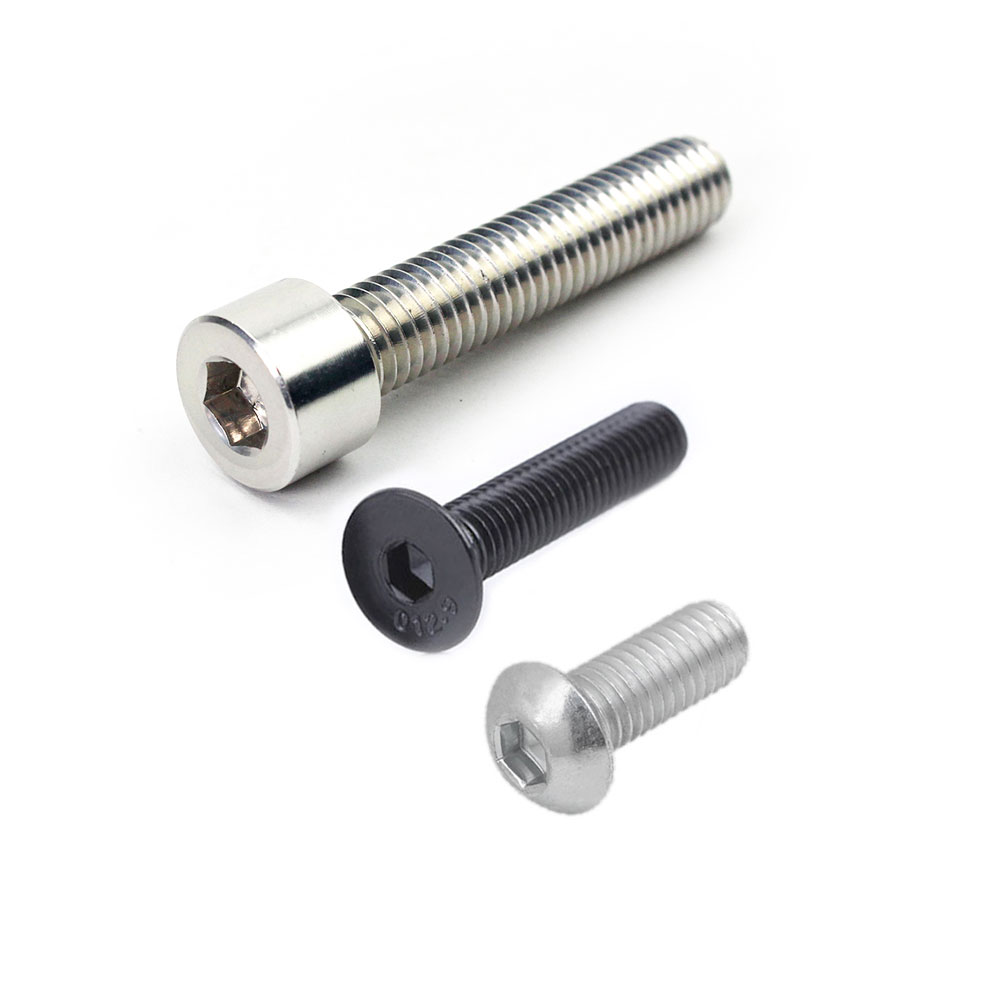
While both utilize an internal hex drive, their structural capacities differ significantly. A standard socket head cap screw features a tall, cylindrical head designed to handle massive torque and heavy structural loads. A button head cap screw has a lower, rounded dome profile. Because the head geometry is smaller, the internal hex drive is shallower. Consequently, button heads cannot handle the same high-torque specifications and are strictly intended for lighter-duty fastening where a smooth, snag-free finish is required.