Views: 0 Author: Site Editor Publish Time: 2026-08-03 Origin: Site
Modern precision manufacturing requires absolute repeatability to remain competitive. Slight misalignments during machining directly impact defect rates. They also drive up operational costs significantly. Slow fixture changeovers severely throttle automated line speeds. Inconsistent workpiece positioning ruins manual assembly efficiency. You must eliminate these bottlenecks to maximize throughput. Specifying the correct Spring Plungers is a critical engineering decision. This choice dictates long-term scalability. It also ensures equipment longevity across your facility. We will explore how proper selection guarantees strict compliance. High-stakes sectors like aerospace and automotive demand this exact rigor. You will learn how to evaluate different mechanisms safely. We will also cover engineering dimensions and implementation realities. You can then optimize your workholding strategy seamlessly.
Application Dictates Type: The choice between a ball spring plunger and a pin-style plunger fundamentally alters load distribution and indexing speed.
Material Drives Lifecycle: Evaluating housing and spring materials against environmental realities (heat, corrosive fluids) prevents premature cyclical wear.
Standardization Over Customization: Leveraging standardized, high-quality spring plungers reduces procurement bottlenecks and simplifies fixture maintenance.
Calculated Forces Control Yield: Verifying initial and final end-force metrics ensures workpieces are secured without surface deformation.
Unreliable locating devices cause dangerous micro-shifts on the production floor. These shifts happen frequently during CNC machining. They also occur during high-speed automated assembly. This movement causes expensive out-of-tolerance scrap. You lose valuable raw material instantly. Production schedules slip behind target dates. Engineers often blame the cutting tools prematurely. Usually, the fixture itself fails to hold the part correctly. Passive clamps cannot adjust to slight material variations. Active tensioning solves this variable effectively.
Effective integration must yield verifiable results immediately. You should see drastic reductions in fixture loading times. You need zero degradation in holding accuracy. This accuracy must last over thousands of production cycles. A poorly chosen device fails quickly. A correctly specified component lasts for years. Engineers measure success through repeatable yields. Less scrap means higher overall efficiency. You can prove this return on investment quickly.
Automated environments require continuous, uninterrupted operation. You must shift from static clamps. Active tensioning allows seamless robotic loading. Robots cannot feel a misaligned part instinctively. The fixture must guide the workpiece perfectly. Active devices provide this necessary tactile guidance. They push the part firmly against a hard stop. The robot can then lock the main clamp safely. This method prevents catastrophic spindle crashes. It also maximizes your machine uptime.
You must align the correct mechanism to your specific application. Using the wrong geometry causes premature wear. It can also damage your workpieces. We categorize these devices by their engaging nose shapes. Each shape serves a distinct mechanical purpose.
The ball spring plunger utilizes a hardened rolling ball. This mechanism excels in lateral detent operations. It works perfectly for sliding applications. These situations require smooth, multi-directional engagement. You get reliable disengagement without manual retraction. The ball rolls over mating surfaces effortlessly. Many engineers deploy spring loaded ball plungers in indexing dials. They provide a satisfying tactile click. This confirms correct positioning to the operator.
A spring plunger pin features a cylindrical or radiused nose. This type handles entirely different stress factors. It is best for applications requiring higher side-load capacity. The solid pin resists lateral shearing forces well. You use them for deep positioning tasks. They also provide heavy-duty ejection. Ejecting stuck parts from stamping dies requires this pin strength.
Manual intervention requires a different approach. You will need retractable options for adjustable fixtures. These feature a manual pull-ring or an automated knob retraction. They are best for rapid changeover indexing. You use them to build secure locking mechanisms. They guarantee safety-critical manual alignment. The operator pulls the ring to unlock the slide. They release the ring to lock the new position securely.
Device Category | Primary Mechanism | Optimal Manufacturing Applications |
|---|---|---|
Ball Plunger | Hardened rolling steel ball | Lateral detents, sliding rails, smooth multi-directional release |
Pin-Style (Nose) | Solid cylindrical or radiused pin | High side-load resistance, deep positioning, heavy part ejection |
Retractable/Indexing | Manual pull-ring or knob | Rapid fixture changeovers, adjustable locking, safety alignments |
Calculating the exact required spring forces is absolutely essential. You must define the initial and final end-force metrics carefully. This balances firm workholding against easy part removal. Avoid over-specifying the spring tension. Excessive force causes rapid operator fatigue. It can also cause severe part damage. Soft materials will dent under too much pressure. You must calculate the mass of your workpiece accurately. Factor in the friction of your sliding mechanism. Account for opposing operational forces like cutting tool pressure.
Material selection determines your environmental compliance. You must match the housing to your factory realities. Different industries enforce strict material mandates.
Steel and Alloy: Choose these for standard high-load manufacturing. They offer excellent tensile strength for heavy machining.
Stainless Steel: This is essential for medical or food-grade environments. Aerospace applications also demand strict corrosion resistance. You cannot risk rust contaminating a cleanroom.
Delrin and Nylon Noses: These are required for securing soft metals. You must use them against aluminum or brass. They prevent unacceptable surface marring during clamping.
Thread and housing architecture also requires careful evaluation. You must choose between standard and fine threads. Fine threads offer greater precision during depth adjustment. They resist backing out slightly better. Consider a specialized spring loaded spring plunger for confined-space installations. Tight aerospace assemblies often lack clearance for bulky clamps. A compact threaded body provides highly predictable compression paths. It fits entirely inside the fixture plate safely.
Installation tolerances present a major integration risk. You must highlight the risk of severe thread binding. Housing deformation occurs if operators over-torque the body. The internal spring channel will warp under pressure. The plunger nose will then jam permanently. Use designated installation wrenches to prevent this. Never use standard locking pliers on the threaded body. Proper tooling guarantees the internal clearances remain perfectly intact.
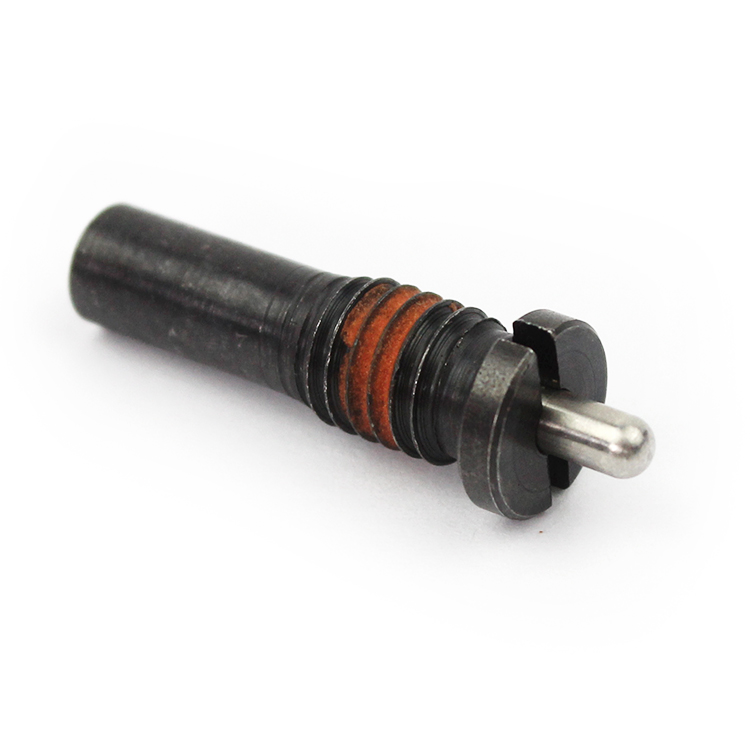
Vibration loosening plagues high-speed machining centers. Standard threads back out during intense milling operations. This causes the locating point to drift gradually. Your parts will slowly fall out of tolerance. Mitigation requires proactive engineering choices. You must specify plungers equipped with pre-applied thread-locking elements. A Nylok patch creates immense friction against the mating threads. This prevents backing out even under severe harmonic vibrations.
Cyclical fatigue is an unavoidable reality. You must transparently acknowledge how all springs degrade. Trustworthy engineering involves planning scheduled maintenance correctly. Do not wait for a catastrophic failure. Schedule replacements based on the manufacturer's rated lifecycle cycles. For instance, replace a spring loaded index plunger every 100,000 cycles proactively. This prevents sudden line stoppages. Preventive replacement costs a fraction of unplanned downtime. Track these usage cycles through your maintenance software reliably.
You need a logical path from initial design to final purchase. Start by auditing your current production fixtures comprehensively. Map exactly where manual clamping slows down your production. Identify specific zones for immediate spring-loaded upgrades. Look for operations requiring repetitive manual adjustments. These are your highest-value targets for active tensioning solutions.
Never order components in bulk without rigorous testing. You must test and validate your theories first. Request sample units from your chosen manufacturer. Validate the calculated end-force against actual workpiece materials. Ensure the nose does not mar the finish. Confirm the operator can actuate the mechanism comfortably. If you need a custom retractable spring plunger, verify the prototype extensively. Real-world testing exposes flaws invisible on a computer screen.
Evaluate your supplier's technical authority carefully. Do not base decisions solely on low per-unit costs. Cheap components fail and destroy expensive workpieces. Shortlist partners who provide robust engineering support. Follow these criteria when vetting suppliers:
Demand comprehensive 3D CAD models for native integration into your fixture designs.
Request transparent load-testing data verifying the spring fatigue limits accurately.
Verify traceable ISO and compliance certifications for strict industry mandates.
Assess their ability to deliver consistent thread tolerances across large batches.
Integrating the right spring plunger transforms unpredictable assembly stages entirely. It turns chaotic manual setups into controlled, repeatable processes. You gain highly efficient operational workflows immediately. Proper selection ensures your fixtures hold tight tolerances consistently. It also protects your sensitive workpieces from unnecessary damage. Your automated lines will run faster and smoother.
Stop relying on guesswork for your workholding strategies.
Review technical specification tables to find your exact mechanical requirements.
Download native CAD files for your specific fixture designs today.
Consult with an engineering specialist to define your exact end-force needs safely.
A: Ball plungers allow passive, roll-over engagement and disengagement based solely on applied force. They push into a detent and roll out when pushed sideways. Index plungers require active manual or mechanical retraction to unlock or adjust the position. You must physically pull the ring or knob to release the mechanism.
A: It requires calculating the exact mass of the workpiece first. You must also measure the friction of the sliding mechanism. Finally, you must add any opposing operational forces, like cutting tool pressure or robotic insertion force. Combine these metrics to specify a spring tension that holds firmly without causing damage.
A: Yes, but specific mathematical limits apply. The pin length, housing material, and engagement depth dictate the total shear strength. A shallow engagement shears much faster than a deep insertion. Always consult the manufacturer's technical data sheet to ensure all safety factors are met before exposing pins to lateral shear.