Views: 0 Author: Site Editor Publish Time: 2026-08-09 Origin: Site
Small mechanical components often dictate the reliability of massive industrial systems. A single failing positioning mechanism can easily halt an entire assembly line. Premature component failure happens far too frequently in modern manufacturing. Common causes include harsh corrosion, incorrect force settings, or poor material selection. Standard fasteners degrade rapidly in hostile industrial environments. These unexpected failures lead to expensive machinery downtime. They also introduce severe safety risks for factory operators.
We must solve this common engineering challenge early in the design phase. This guide provides a definitive evaluation framework for engineering teams. It helps you specify stainless steel variants over weaker alternatives. We will thoroughly explore how to optimize overall cycle life. You will also learn how to guarantee structural integrity under load. Finally, we will ensure operational safety for your high-value precision assemblies.
Material Supremacy: Stainless steel (typically 303 or 316) offers superior chemical resistance and temperature tolerance compared to carbon steel or Delrin, though at a higher initial unit cost.
Tip Selection: The choice between a ball tip and a pin tip dictates load distribution and indexing speed.
Specification Precision: Accurate matching of initial/final end forces and stroke lengths is mandatory to prevent mechanical jamming or component fatigue.
Installation Reality: Factoring in thread type, installation method (hex socket vs. slotted), and anti-galling measures is essential for long-term maintenance.
Material selection forms the absolute foundation of mechanical reliability. Engineers must evaluate material grades strictly during the prototyping phase. Stainless steel vastly outperforms softer alternatives in harsh conditions. You should specify 303 stainless steel for standard industrial applications. Grade 303 provides excellent baseline machinability. It also offers reliable baseline corrosion resistance. General manufacturing jigs benefit greatly from 303 alloys. They balance strength and production efficiency perfectly.
However, specialized environments demand stronger metallurgical properties. Marine, medical, or food-grade sectors require grade 316 stainless steel. These sectors guarantee continuous exposure to aggressive cleaning chemicals. Saltwater and heavy chlorides destroy weaker metals rapidly. Grade 316 excels in these extreme chemical environments. The added molybdenum prevents pitting and crevice corrosion completely. High-grade Spring Plungers made of stainless steel guarantee robust longevity.
Next, consider the mechanical trade-offs against Delrin or standard carbon steel. Delrin carries inherent wear risks under heavy side-loads. Plastic threads strip easily during repetitive adjustments. Stainless steel completely eliminates these deformation risks. It handles heavy sheer forces effectively day after day. Stainless also heavily outperforms standard carbon steel. High-humidity environments quickly rust untreated carbon steel. Fluid-heavy applications demand superior fluid resistance. Carbon steel requires frequent protective coatings. These coatings wear off quickly during normal cyclic friction.
Stainless steel admittedly requires a higher upfront financial investment. However, you achieve a significantly higher return on long-term investment. Automated, high-cycle environments benefit immensely from this inherent durability. Fewer replacements mean fewer maintenance shutdowns over the machine's lifespan. Component reliability directly drives production profitability.
Material Performance Matrix
Material Type | Relative Durability | Corrosion Resistance | Primary Application |
|---|---|---|---|
Stainless Steel (303) | High | Good | Standard Industrial Jigs |
Stainless Steel (316) | Very High | Excellent | Medical and Marine Equipment |
Carbon Steel | High | Low | Dry, Indoor Automation |
Delrin / Plastic | Low | Excellent | Light Load, Non-Marring Uses |
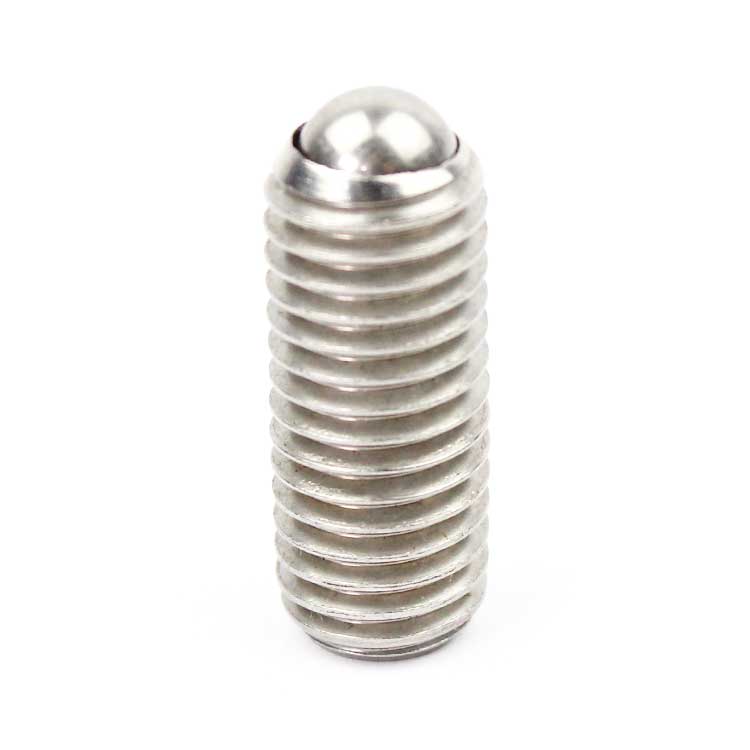
Selecting the correct tip changes your mechanism's entire kinetic behavior. A ball spring plunger utilizes a hardened stainless steel ball. This rolling mechanism facilitates smooth engagement. It also allows seamless, low-friction disengagement. You should use ball tips to manage lateral side loads. They perform exceptionally well in frequent detent operations. High-speed indexing dials rely heavily on them to reduce friction.
Conversely, a spring plunger pin operates very differently. We often call this variant a nose plunger. It features a solid cylindrical pin extending from the housing. Manufacturers usually chamfer or radius this pin for slight entry guidance. This rugged design handles high lateral sheer forces effortlessly. It ensures deep indexing and highly secure locking. Use a pin when a rolling action is undesirable. Rolling actions might cause accidental disengagement in heavy-duty setups. Choose pins for rigid, stationary positioning tasks.
Best Practice for Ball Tips: Apply them where operators manually rotate dials. The rolling ball significantly reduces operator hand fatigue.
Best Practice for Pin Tips: Deploy them in heavy stamping dies. The solid pin resists immense vibrational shear forces efficiently.
Common Mistake: Specifying a ball tip for heavy vertical load bearing. Balls can slip easily under direct vertical pressure.
Automated systems often require advanced manual overrides for safe maintenance. A retractable spring plunger provides highly reliable manual control. These solutions feature integrated manual pull-rings. Some ergonomic designs use L-handles or T-handles instead. They allow operators to manually disengage the internal plunger head safely. These manual variants are absolutely critical for quick-change fixtures. You also see them heavily utilized in adjustable shelving systems. Rapid tooling changeovers rely entirely on these manual retractors.
You must also consider strict spatial integration constraints. A spring loaded index plunger typically includes engineered locking positions. Engineers professionally call these "rest positions." The pin secures itself in the fully retracted state. Operators pull the handle and twist it ninety degrees. The pin stays safely locked out of the way. This prevents accidental deployment during sensitive maintenance procedures.
Implementation requires careful spatial evaluation. You must evaluate the physical footprint carefully inside your CAD environment. T-handles require more vertical clearance above the mounting block. Knurled knobs need less vertical space but demand wider finger clearance. Always check your 3D spatial clearance before final specification. Jammed handles create severe ergonomic hazards for your workforce.
Proper technical specification prevents catastrophic mechanical failures later. Begin by clearly defining your required end forces. Manufacturers categorize these into light, standard, and heavy force ratings. You must actively distinguish between initial end force and final end force. Initial force represents the immediate pre-load. Final force applies when the spring is fully compressed. The physics of spring compression dictate a linear increase in resistance.
Risk mitigation plays a huge role here. Over-specifying heavy forces causes excessive mechanical wear. The mating parts will degrade rapidly under immense friction. Under-specifying causes loose indexing and poor alignment. Precision suffers drastically. You must find the exact mathematical balance for your application.
Stroke length requirements are equally critical to success. Assess standard options against long-stroke variants carefully. Long-stroke variants serve highly specific applications very well. They easily accommodate wider dimensional tolerances in welded assemblies. Deep locking channels also strictly require extended strokes for secure engagement.
Thread sizes and pitch require close attention during design. You can choose metric sizes ranging from M3 to M24. Imperial thread sizes are also widely available globally. Fine threads offer significantly better vibration resistance. However, they require highly precision tapping inside the mounting block. Coarse threads install faster but may vibrate loose over time.
Finally, evaluate the complete mechanical assembly holistically. When sourcing a fully assembled spring loaded spring plunger, verify internal materials. The internal coil spring must match the housing's environmental rating. Corrosive environments will destroy an unrated carbon spring quickly. A stainless housing cannot protect a rusting internal spring from moisture intrusion.
Even mathematically perfect specifications fail during improper physical installation. Identify your preferred drive type early in the design phase. Slotted drives allow easy installation from the rear only. Hex socket designs allow installation from either end. This dual-sided flexibility speeds up factory assembly times significantly. It also allows for higher installation torque without stripping.
Stainless-on-stainless thread galling presents a massive recognized industry risk. Galling involves localized cold welding between thread flanks under pressure. It locks the threads together permanently. We highly recommend specific anti-seize lubricating compounds. Pre-applied Nylok patches also prevent galling during initial installation. They double as excellent anti-vibration elements.
Contamination poses another very significant operational threat. Open-ended housing designs easily accumulate loose machining chips. Factory dust also packs tightly into open cavities. You should specify fully sealed units for dirty environments. You can also add physical deflectors above the installation point. Heavy milling environments demand these active physical protections to maintain spring functionality.
Follow this shortlisting logic to finalize your choice:
Define exact environmental exposure including harsh corrosives and temperature extremes.
Calculate the mathematically required lateral and axial holding forces.
Determine manual versus automated mechanical retraction needs.
Validate 3D spatial constraints for total housing length and thread size.
Your chosen spring loaded ball plungers assembly must pass all four checks. Do not compromise on any single requirement.
Stainless steel indexing components remain structurally indispensable today. They consistently deliver durable, high-reliability locating and precision indexing. Proper material selection definitively prevents premature mechanical failures. Accurate force calculations ensure reliably smooth mechanical operations. Correct installation techniques prevent permanent and costly thread damage.
We strongly advise engineers to transition from evaluation to physical validation now. Download native 3D CAD models from trusted component suppliers. Test spatial fits directly inside your digital software assemblies. Contact application engineers for specific physical sample requests. You can safely negotiate bulk procurement pricing once physical validation is fully complete.
A: A ball plunger utilizes a hardened ball for smooth rolling friction. It engages and disengages quickly, making it ideal for frequent detent operations. A pin plunger features a solid cylindrical nose. It offers much higher shear strength for deep locking where you must prevent accidental disengagement.
A: Yes, they perform very well in high temperatures. However, the maximum temperature limit heavily depends on the internal spring material. Standard steel springs may lose their temper and weaken long before the outer stainless housing degrades. Always specify high-heat internal springs for extreme applications.
A: Stainless-on-stainless friction frequently causes thread galling. You can prevent this by applying specific thread lubricants or anti-seize compounds. Avoid using high-speed power tools during installation. Additionally, consider ordering units with pre-applied thread-locking patches. These patches prevent galling and double as excellent anti-vibration elements.
A: Yes, manufacturers offer long-stroke variants in standard grades. However, these mechanisms require a substantially longer housing body. This extended body accommodates the uncompressed spring safely. You must account for this increased length, as it directly affects your required mounting depth and overall spatial footprint.