Views: 0 Author: Site Editor Publish Time: 2026-08-26 Origin: Site
Securing fixtures to masonry and concrete substrates requires specialized fastening mechanics. Utilizing the wrong anchor type routinely leads to catastrophic pullout failures, spalling, or structural detachment. Engineers, contractors, and facility managers must determine the precise fastening mechanism for a given load. You have to balance holding strength, installation speed, and substrate integrity without over-engineering the solution. Field conditions rarely match laboratory environments. You deal with varying concrete compressive strengths, hidden rebar, and tight edge clearances on a daily basis.
This guide evaluates the technical applications of the concrete screw anchor. We compare its mechanical performance against alternative fasteners to establish clear criteria for specification and implementation. You will see exactly how these fasteners behave on active job sites across solid concrete, hollow block, and brick.
Mechanical Interlock: Unlike expansion anchors, a self tapping concrete screw cuts its own threads into masonry, providing high pullout resistance without exerting outward stress on the base material.
Application Scope: Engineered for a wide spectrum of loads—ranging from heavy pipe support systems to residential brackets and mailboxes—across solid concrete, hollow brick, and stone.
Edge Proximity Advantage: Because they do not create expansion forces, concrete screw anchors can be installed significantly closer to concrete edges and adjacent anchors without risking substrate fracture.
Installation Sensitivity: Performance is strictly dependent on precise pilot hole sizing, thorough dust evacuation, and strict torque control to prevent thread stripping or anchor snapping.
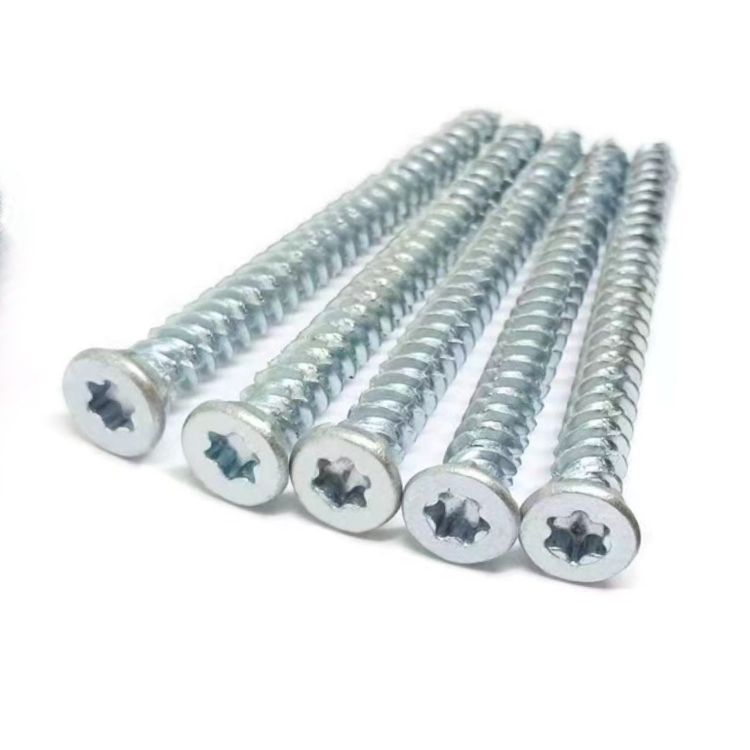
Fastening into masonry means overcoming the dense, brittle nature of concrete. A self tapping concrete screw handles this through a specialized thread design. Most feature an alternating high-low thread pattern. The high threads cut deep into the concrete matrix to create a mechanical interlock. The low threads stabilize the fastener and pack displaced concrete dust tightly against the hole walls. This dual-action thread profile maximizes surface area contact within the drilled hole.
This cutting action forms a direct mechanical bond with the base material. Traditional sleeve or wedge anchors rely on expansion force. They wedge a metal collar outward against the concrete to create friction. Screw anchors do not generate this outward wedging force. This fundamental mechanical difference eliminates internal stress within the concrete substrate. You can safely install them in fragile or aging masonry without blowing out the material.
Attempting to drive a standard fastener into concrete results in immediate failure. Standard wood or machine screws possess inadequate thread pitches for masonry. Their threads are too fine or too soft to cut through hard aggregate. Installers often try to pair standard screws with friction-fit plastic wall plugs. These plugs degrade over time, shrink in fluctuating temperatures, and offer minimal shear strength. When exposed to UV light or chemical solvents, plastic plugs become brittle and shatter under load.
Concrete screws undergo specialized hardening processes. Manufacturers use carbon steel or stainless steel, applying induction hardening to the lead threads. This hardens the tip enough to cut through concrete and aggregate without shearing. The body of the screw remains slightly more ductile. This ductility prevents the fastener from snapping under lateral shear loads. Standard fasteners lack this dual-zone metallurgical profile, making them entirely unsuitable for direct masonry embedment.
Metallurgical and Mechanical Comparison | ||
Feature | Concrete Screw Anchor | Standard Fastener (Wood/Machine) |
|---|---|---|
Thread Profile | High-low alternating threads | Uniform, fine or coarse threads |
Hardening Process | Induction hardened lead threads | Uniform case hardening (if any) |
Installation Method | Direct drive into pilot hole | Requires plastic/lead wall plug |
Shear Strength | High (ductile body absorbs stress) | Low (prone to snapping in masonry) |
Commercial construction relies heavily on concrete screws for medium-to-high load applications. Contractors specify these fasteners to mount heavy HVAC equipment to concrete pads. They secure overhead pipe support systems and suspend cable trays from concrete ceilings. Facility managers use them to anchor heavy-duty warehouse racking to floor slabs. The speed of installation keeps large-scale commercial projects on schedule.
In commercial framing, these anchors secure steel door frames to block walls. They provide reliable shear strength to prevent frames from shifting under heavy door cycles. The mechanical interlock ensures the anchor holds fast, even under the dynamic loads of industrial environments. You will also see them used extensively in mounting electrical conduit boxes and heavy transformer panels to poured concrete walls.
Residential applications require reliable holding power without heavy hammer drills or complex epoxy systems. Homeowners and tradespeople use screw anchors to attach light fixtures directly to brick mortar joints. They mount heavy mailboxes to stone pillars and secure metal shelving brackets to basement walls. The holding power far exceeds what a plastic wall anchor can provide.
Exterior residential applications include installing address signage, securing hose reels, and fastening downspout brackets. You can drive the anchor with a standard impact driver or drill, making it highly accessible for light-duty fixture installation. Landscapers frequently use them to secure timber retaining wall brackets into concrete footings.
Expansion anchors create a cone of stress inside the concrete. If you install them too close to an edge, this stress causes the concrete to split or blow out. Screw anchors eliminate this expansion force. This characteristic makes them the primary choice for tight spaces where edge distances are severely restricted.
Contractors use them to secure wood sill plates to the very edge of a foundation wall. They anchor metal railing baseplates near the edge of concrete balconies. Technical rules of thumb generally allow screw anchors to be installed as close as 1.5 to 2 inches from a concrete edge. Expansion anchors typically require a minimum of 3 to 4 inches of edge clearance to prevent substrate fracture.
Construction workflows frequently require temporary anchoring. Scaffolding ties must be secured to building facades and removed later. Concrete formwork requires strong bracing during the pour, which must be dismantled once the concrete cures. Temporary safety barriers and construction signage also require secure but removable fastening.
Screw anchors are fully removable. You simply reverse the drill to back the screw out of the hole. The concrete surface remains relatively flush, requiring only a small patch. Wedge anchors are permanent. Once hammered in and expanded, you cannot extract them. You have to cut them off flush with an angle grinder, leaving steel embedded in the substrate.
Fastening conditions vary wildly across a single job site. A screw anchor provides consistent holding performance across multiple base materials. You do not need to switch fastener types when moving from a poured foundation to a brick facade.
Solid Poured Concrete: Offers the highest pullout and shear strength due to dense aggregate engagement. The threads cut deeply into the cured cement paste.
Hollow Concrete Block (CMU): The anchor threads lock into the thin outer web of the block without cracking the fragile masonry. Expansion anchors easily shatter hollow block.
Solid Brick: Cuts cleanly into fired clay without causing the brick to shatter or flake.
Mortar Joints: Provides a secure hold in softer mortar, though load capacities are reduced compared to solid brick. Installers must account for the lower compressive strength of mortar.
Selecting between a screw anchor and a concrete anchor bolt depends entirely on the load threshold. Screw anchors handle medium-duty loads exceptionally well. Under optimal conditions in solid concrete, a heavy-duty screw anchor can hold thousands of pounds of static load. They are more than capable of handling standard framing, racking, and equipment mounting.
Extreme structural loads require a concrete anchor bolt. Wedge anchors or chemical epoxy anchors provide massive shear and pullout resistance. They are mandatory for structural steel columns, heavy machinery subjected to extreme vibration, and seismic retrofitting. If the application involves life-safety structural connections, engineers default to heavy-duty anchor bolts to guarantee maximum load transfer.
Labor time heavily influences fastener selection on large projects. Screw anchors offer a streamlined, two-step installation process. You drill the pilot hole and immediately drive the screw. This scalability allows contractors to install hundreds of anchors per day with minimal fatigue. The reduction in labor hours directly impacts project profitability.
Traditional anchor bolts require a more labor-intensive workflow. You must drill a larger hole, thoroughly clean the hole with wire brushes and compressed air, hammer the bolt into the concrete, and finally apply precise torque with a wrench to set the expansion wedge. For non-structural applications, the labor savings of a screw anchor are substantial.
Industrial environments introduce constant vibration from heavy machinery, forklifts, and HVAC units. Friction-based expansion anchors can slowly work themselves loose under continuous dynamic loads. The vibration breaks the friction bond between the expansion clip and the concrete, causing the anchor to slip outward.
Screw anchors resist vibration loosening through their mechanical interlock. The threads are physically embedded into the concrete matrix. This continuous engagement prevents the fastener from backing out, making it highly reliable for mounting motors, pumps, and conveyor systems. The physical barrier of the cut threads stops the anchor from vibrating loose.
Technical Comparison: Concrete Screw Anchor vs. Concrete Anchor Bolt | ||
Feature | Concrete Screw Anchor | Concrete Anchor Bolt (Wedge Anchor) |
|---|---|---|
Holding Mechanism | Mechanical thread interlock | Friction-based expansion |
Load Capacity | Light to Medium-Heavy Duty | Heavy Structural Duty |
Edge Proximity | Excellent (can be installed close to edges) | Poor (requires large edge clearance) |
Removability | Fully removable | Permanent (must be cut off) |
Installation Speed | Fast (Drill and drive) | Slower (Drill, clean, hammer, torque) |
Base Material | Solid concrete, hollow block, brick, mortar | Solid concrete only |
Concrete screws come in two primary head styles, each serving a distinct mechanical purpose. Hex-washer heads provide a broad bearing surface. This style excels at high-torque installations and effectively distributes the load across the fixture. Contractors use hex heads for mounting sheet metal, heavy brackets, and strut channels. The built-in washer prevents the head from pulling through thin materials.
Flat or countersunk heads are required when the fastener must sit flush with the material surface. Installers use flat heads for securing wood furring strips, metal drywall tracks, and door hinges. The flush finish prevents interference with subsequent construction layers. Using a hex head on a drywall track would cause the drywall to bulge outward.
Environmental exposure dictates the required fastener coating. Specifying the wrong coating leads to rapid galvanic corrosion, rust bleeding, and eventual anchor failure. You must match the metallurgy to the job site conditions.
Standard Zinc-Plated: Suitable only for dry, interior environments with climate control. Exposure to moisture will cause rapid rusting.
Mechanically Galvanized or Ceramic Coated: Designed for exterior use, damp environments, and treated lumber applications. These coatings resist weather-induced corrosion and the harsh chemicals found in pressure-treated wood.
410 and 316 Stainless Steel: Mandatory for coastal environments, chemical processing plants, or submerged applications. 316 stainless steel provides the highest level of corrosion resistance available, preventing chloride-induced pitting.
The compressive strength of the concrete directly impacts holding power. Older, fully cured concrete with a high PSI provides maximum thread engagement. Green or deteriorating concrete yields lower pullout values. You must assess the substrate before specifying the anchor size.
Embedment depth must align with manufacturer specifications. A standard rule requires a minimum embedment of 1 inch into solid concrete, though 1.5 to 2 inches is optimal for structural stability. Driving the anchor too deep increases friction and raises the risk of snapping the screw during installation. You gain diminishing returns on holding power once you exceed the manufacturer's maximum embedment depth.
Concrete screw performance relies entirely on the pilot hole. You must use the exact ANSI-standard carbide drill bit diameter specified by the manufacturer. Using a worn bit or the wrong size compromises the installation. For example, a 3/16-inch screw strictly requires a 5/32-inch drill bit. A 1/4-inch screw requires a 3/16-inch bit. If the bit is worn down, the hole will be too tight, and the screw will snap.
The pilot hole must be drilled at least 1/4 to 1/2 inch deeper than the intended anchor embedment. This extra depth creates a reservoir for the concrete dust generated as the screw cuts its threads. Without this reservoir, the screw will bottom out on the dust, preventing full insertion and leaving the fixture loose.
Trapped concrete dust causes severe mechanical failure during installation. As the screw drives inward, dust packs tightly around the threads. This increases friction exponentially. The screw binds in the hole, and the rotational force of the drill snaps the hardened steel head off. This leaves the shank permanently embedded in the concrete.
Standard clearing procedures mitigate this risk. You should use a wire brush to loosen dust from the hole walls. Follow this by blowing the hole clean with compressed air or a specialized vacuum attachment. Clean holes ensure smooth thread cutting and accurate seating. Skipping this step is the leading cause of fastener failure on job sites.
High-torque impact drivers present a significant risk during installation. While they drive screws quickly, they can easily over-torque the fastener once the head meets the fixture. Over-torquing strips the newly cut concrete threads, instantly reducing the anchor's holding power to zero. The screw will spin freely in the hole.
Installers should use drills with adjustable clutch settings or release the impact driver trigger the moment the head seats. If a hole strips, practical remediation steps exist. You can salvage the mounting point using the following methods:
Inject Structural Epoxy: Fill the stripped hole with a fast-curing masonry epoxy, insert the screw, and allow it to cure. This bonds the screw permanently to the substrate.
Upsize the Fastener: Drill the hole out with a larger masonry bit and install a larger diameter concrete screw.
Relocate the Anchor: If the hole is completely compromised, patch it with hydraulic cement and drill a new pilot hole at least 2 inches away to avoid the fractured failure radius.
Take the following actions to ensure successful implementation on your next project:
Consult manufacturer technical data sheets for specific ultimate and allowable load tables before specifying an anchor for structural loads.
Verify that your procurement order includes the exact-match ANSI masonry drill bits required for the specified anchor diameter.
Implement strict job site protocols for dust evacuation and torque control to eliminate snapping and stripping failures.
Specify stainless steel variants for any exterior application exposed to coastal air or chemical agents.
A: Yes, they can be easily backed out and removed. However, reusing the exact same screw in a new hole is not recommended. The lead threads wear down during the initial installation, reducing their ability to cut fresh concrete effectively in a second application.
A: Standard embedment requires a minimum of 1 inch into solid concrete, though 1.5 to 2 inches is recommended for maximum holding power. Always drill the pilot hole 1/4 to 1/2 inch deeper than the intended embedment to accommodate concrete dust.
A: Yes. They are highly effective in hollow concrete masonry units. The threads lock securely into the outer web of the block. Because they do not expand, they will not crack or blow out the fragile hollow block during installation.
A: Snapping usually occurs due to excessive friction. This happens if the pilot hole is too shallow, if concrete dust is not cleared from the hole, or if the installer uses an oversized impact driver that applies too much rotational torque.
A: If the concrete threads strip, you can inject a structural masonry epoxy into the hole and re-insert the screw. Alternatively, you can drill the hole slightly larger and use a larger diameter screw, or relocate the mounting point entirely.
A: Because they do not exert outward expansion forces, they can be installed much closer to edges than wedge anchors. Generally, you can install them 1.5 to 2 inches from an edge, but always consult the manufacturer's technical data sheet for exact minimum edge distances.