Views: 0 Author: Site Editor Publish Time: 2026-06-20 Origin: Site
Standard cup or cone point set screws can wreak havoc on precision surfaces. When a hardened alloy fastener digs into a softer shaft, it causes severe galling and creates raised burrs. It ultimately ruins expensive ground finishes. These seemingly minor scars create massive headaches during component disassembly. Maintenance technicians struggle to remove collars, and sliding a tight-tolerance bearing over a burred shaft often destroys the bearing entirely.
Engineered no-mar tip set screws act as the ideal alternative for these high-stakes fastening scenarios. They perform exceptionally well in high-frequency adjustment applications. They also excel when clamping onto delicate substrates, such as spindle shoulders or threaded surfaces lacking a machined flat. By integrating a softer insert at the point of contact, they secure parts without destroying the underlying geometry.
This guide evaluates various tip materials, torque limitations, and critical implementation criteria. We will help procurement and engineering teams select the right fastener. You will learn how to maintain strong holding power while fully protecting your most valuable machined components.
No-mar tip set screws rely on compressive friction rather than material penetration to secure components, protecting expensive shafts and ground finishes.
Material selection is the primary performance variable: nylon tips offer vibration damping and conformability, while brass tips support higher torque loads and temperature thresholds.
Adopting no-mar fasteners requires adjusting torque specifications; over-torquing soft tips can lead to tip deformation or extrusion.
Combining tip set screws with secondary locking mechanisms (like thread-locking patches) provides optimal security for high-vibration applications.
Standard grub screws secure components through mechanical penetration. A traditional cup point or cone point screw features a sharp, hardened steel edge. When you apply tightening torque, this edge pierces the softer metal of the shaft. It displaces material to create a mechanical lock. This penetration clamping guarantees a strong hold, but it permanently damages the substrate.
This localized damage triggers a chain reaction of mechanical failures. The displaced metal does not disappear. It pushes outward to form a raised rim, commonly known as a burr. Burr formation complicates basic component removal. When you attempt to slide a pulley, gear, or collar off the shaft, it catches on this raised metal. If you force a close-tolerance bearing over a burred section during disassembly, the hardened burr scores the delicate inner race. This instantly ruins the bearing.
Threaded surfaces suffer similar degradation. If you secure a standard screw directly onto a threaded rod, the sharp point crushes the thread crests. You can no longer thread nuts or fittings past that damaged zone. This forces technicians to cut the rod or replace it entirely.
Transitioning to protective fasteners serves as a powerful risk mitigation strategy. You stop scrapping expensive parts. You also eliminate excess machining time. Engineers often mill flat spots (D-shafts) on round stock specifically to give standard screws a safe place to bite. Milling these flats requires additional machine setups and increases production time. By implementing high-quality tip set screws, you bypass the need for milled flats. You accelerate assembly times and prevent costly field-service delays.
Protective fasteners abandon penetration clamping entirely. Instead, they utilize compressive friction clamping. When you tighten the fastener against a shaft, the soft insert makes initial contact. As torque increases, the insert yields slightly. It deforms just enough to match the exact contour of the shaft. This creates a massive contact patch compared to a standard point. This enlarged surface area generates tremendous friction. The friction holds the component securely in place without piercing the metal.
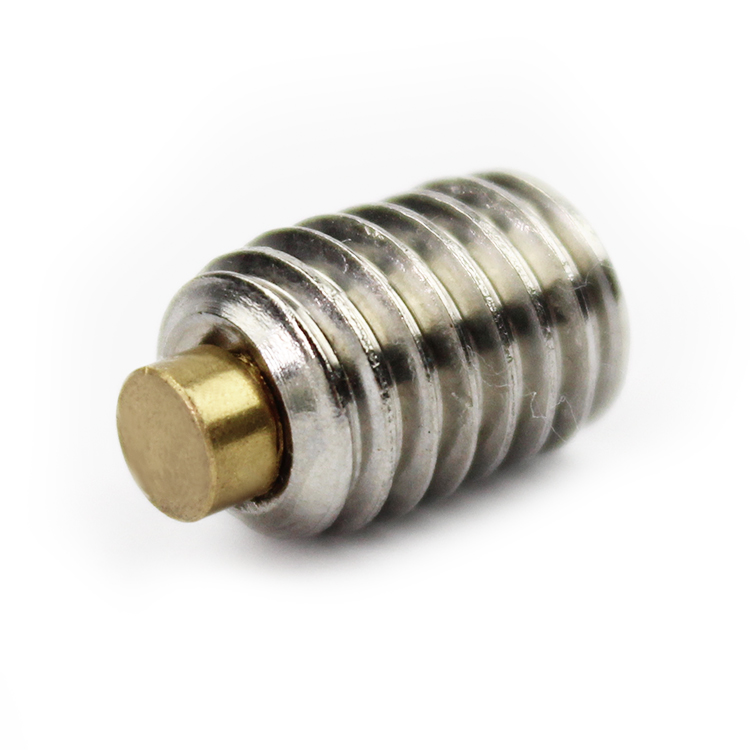
The design architecture makes this possible. Manufacturers start with a hardened threaded body. They typically use alloy steel or stainless steel to ensure strong thread engagement and prevent stripping. They hollow out the driving end to create a small cavity. Finally, they permanently press a soft protective insert into this cavity. The insert protrudes slightly past the steel body. This protrusion ensures only the soft material touches your delicate component.
Machinists and mechanical engineers rely on these specialized fasteners for specific ideal use cases. They frequently use them for securing components on threaded rods. Because the soft tip conforms to the shape of the threads, it holds tight without flattening the delicate crests. They also excel at protecting precision ground finishes. Grinding a shaft to tight tolerances costs significant time and money. A soft tip preserves that finish perfectly. Finally, they dominate frequent-adjustment fixturing. If you build a jig requiring daily realignments, standard screws will quickly chew up the guide rails. Protective tips allow endless adjustments while keeping the rails pristine.
Material selection dictates how the fastener will perform in your specific environment. You must match the tip material to your substrate hardness, operating temperature, and required holding force. Below is a detailed feature-to-outcome breakdown.
Nylon serves as the most common polymer insert. It offers exceptional conformability and surface protection.
Strengths: Nylon conforms closely to highly irregular surfaces. It easily molds into thread valleys and around tight curvatures. The polymer structure provides inherent vibration resistance, acting as a micro-shock absorber. It also completely prevents metal-to-metal contact, eliminating the risk of galvanic corrosion between dissimilar metals.
Limitations: Polymers possess a lower maximum temperature threshold. Standard nylon begins to soften significantly above 200°F (93°C). Furthermore, nylon is susceptible to extrusion. If you drastically over-torque the fastener, the plastic will squish out the sides of the cavity, ruining the tip.
Brass offers a robust middle ground between soft plastics and hard steel points.
Strengths: Brass boasts a significantly higher torque capacity than polymers. You can tighten these fasteners harder, yielding a stronger frictional grip. Brass handles much higher operating temperatures without deforming or melting. It proves excellent for securing harder steel shafts. It grips tightly without leaving indentations on standard steel alloys.
Limitations: While brass protects steel, it can still cause micro-marring on very soft materials like aluminum or unhardened copper. Additionally, brass is electrically conductive. You cannot use it where electrical isolation is a strict requirement.
Some extreme engineering applications require niche inserts like silver, pure copper, or silver-solder tips.
Strengths: These specialty metals become necessary for extreme heat environments. They also perform perfectly in ultra-high vacuum chambers where plastics would outgas and contaminate the environment.
Limitations: These options carry a much higher cost. They suffer from niche availability and often require custom manufacturing runs with long lead times.
To simplify material selection, review this comparative chart outlining key performance indicators for each common tip type.
Tip Material Comparison Chart | ||||
Tip Material | Compressive Strength | Temperature Resistance | Best Substrate Match | Vibration Damping |
|---|---|---|---|---|
Nylon | Low | Up to 200°F (93°C) | Aluminum, Brass, Plastics, Threaded Rods | Excellent |
Brass | Medium-High | Up to 500°F+ (260°C+) | Carbon Steel, Stainless Steel, Hardened Alloys | Poor |
Copper | Medium | Up to 600°F+ (315°C+) | Medium Steels, Specialized Aerospace Shafts | Poor |
Silver Solder | Medium-Low | Extreme High Temp | Vacuum Chambers, High-Heat Furnace Fixtures | None |
Switching to protective fasteners requires a shift in assembly techniques. You cannot treat them exactly like traditional alloy screws. You must manage torque carefully and implement secondary locking strategies to guarantee success.
Engineers often make a critical mistake during implementation. They assume protective screws require the same torque values as standard alloy set screws. This assumption leads to immediate fastener failure. Standard torque charts account for the sheer strength of solid alloy steel. Protective fasteners rely on a much weaker insert.
You must calculate your safe seating torque based on the tip material's yield strength. If you apply 12.9-grade torque to a nylon insert, the nylon crushes instantly. It extrudes out of the socket, allowing the hard steel shell to grind against the shaft. Brass withstands more force but will still deform permanently if pushed past its yield limit. Always consult the manufacturer's specific torque guidelines for tipped fasteners.
Standard cup points resist backing out because they dig a physical crater into the shaft. They create their own mechanical interference fit. Soft tips do not create craters. They rely entirely on compressive friction. Consequently, vibration poses a major risk. Severe machine vibration can overcome this friction, causing the fastener to back out gradually.
You should evaluate secondary locking methods to maintain holding power. Many manufacturers offer pre-applied nylon thread patches. These patches create prevailing torque on the external threads, holding the screw tight even if tip friction fluctuates. Alternatively, you can apply chemical threadlockers during assembly. These liquid adhesives cure in the absence of air, locking the threads securely without relying on the tip biting into the metal.
Because these fasteners rely strictly on friction, the condition of the substrate matters immensely. Oil, grease, and machining coolants act as lubricants. They drastically reduce the friction coefficient between the soft tip and the shaft.
You must prepare the surface properly before final assembly. Follow these operational steps to maximize holding power:
Degrease the substrate: Wipe the shaft or threaded rod with a fast-evaporating solvent to remove all cutting fluids and oils.
Clean the tapped hole: Blow out the internal threads of the collar or gear to ensure no trapped oil pushes onto the tip during installation.
Apply threadlocker: If using a liquid chemical lock, apply it sparingly to the fastener threads, avoiding the soft tip.
Seat the fastener: Thread the screw by hand until the soft tip makes initial contact with the substrate.
Apply precise torque: Use a calibrated torque limiting screwdriver to apply the exact manufacturer-specified seating torque.
Finding the right supplier involves more than just matching a thread pitch. Procurement teams and design engineers must scrutinize technical specifications to avoid subpar products. Poorly manufactured protective fasteners often fail prematurely, causing unexpected downtime.
When reviewing vendor catalogs, you must look closely at the spec sheets. The most critical dimension is the tip protrusion. The spec sheet must clearly state how far the soft tip extends beyond the metal body. If the protrusion is too shallow, the insert will compress fully under load. The hard steel body will then bottom out against your delicate shaft, causing the exact marring you tried to prevent.
You also need verified material grades for both the body and the tip. A supplier might list "stainless steel," but you need to know if it is 303, 304, or 316 stainless to assess corrosion resistance. Similarly, "brass" can refer to many alloys. Request specific material designations for your specialized tip set screws.
Global manufacturing requires strict material compliance. You must check for RoHS (Restriction of Hazardous Substances) and REACH compliance. This is especially vital for specific plastic polymers and certain brass alloys that might contain trace amounts of lead. Non-compliant fasteners can halt your entire product export process.
Additionally, ensure the fasteners adhere to recognized dimensional standards. Look for ASME standards in the US or DIN standards in Europe. Standardization guarantees the hex drive socket will not strip out easily and the threads will gauge correctly.
We highly recommend implementing a pilot testing strategy before full-scale manufacturing adoption. Do not blindly swap out fasteners across your entire production line. Validate the holding force in a controlled environment first.
Vendor & Testing Checklist | ||
Criteria Category | Items to Verify | Pass/Fail Indicator |
|---|---|---|
Dimensional Accuracy | Tip protrusion, Thread pitch, Hex depth | Meets ASME/DIN standards precisely |
Material Verification | Body alloy grade, Tip material specs | Certificates of compliance provided |
Pilot Test Rig | Slip resistance, Torque yield limit | Fastener holds target load without tip extrusion |
Regulatory Compliance | RoHS, REACH documentation | Zero restricted substances present |
Build a small assembly. Apply your calculated torque. Use a force gauge to measure how much lateral load it takes to induce slipping. Once you confirm the holding force meets your operational requirements, you can confidently roll out the new fasteners to the factory floor.
Preventing surface damage fundamentally requires matching your insert material to the substrate hardness and the application's unique torque demands. Nylon excels at vibration damping and conforming to threads, while brass handles higher temperatures and heavier torque loads on steel shafts. Calculating precise seating torque and utilizing secondary locking patches ensures these fasteners perform flawlessly over long lifecycles.
Your next steps should involve a thorough review of your current assembly schematics. Identify high-risk marring zones where standard screws currently damage expensive bearings, ground shafts, or threaded rods. Request samples of both nylon and brass variants from your supplier. Conduct rigorous torque-yield testing on your shop floor to finalize the perfect non-destructive fastening solution for your assemblies.
A: Yes, they can be reused. However, the soft tip may permanently deform over time under heavy compressive loads. This permanent deformation reduces the tip's effectiveness in high-precision re-seating applications. If you remove the fastener frequently, we recommend inspecting the tip for excessive flattening and replacing it if necessary.
A: Yes, they are highly recommended for these specific geometries. The soft insert conforms slightly to the curve of a bare shaft or the crests of a threaded rod. It secures the component tightly without crushing the threads or requiring a costly milled flat.
A: The holding power of a nylon tip is demonstrably lower. It lacks the mechanical penetration and "bite" of a hardened cup point. Applications using soft tips must rely strictly on high surface friction and proper thread locking mechanisms to maintain a secure hold.
A: The standard industry range for nylon inserts is typically around 200°F to 250°F (90°C to 120°C). Operating above these temperatures will cause the nylon to soften or melt. We advise switching to brass or alternative metal tips for anything exposed to higher heat.