
Views: 0 Author: Site Editor Publish Time: 2026-03-24 Origin: Site


If you have ever wondered why some machines “click” into place so smoothly, why a cover panel stays shut without a complicated latch, or how an indexing plate reliably finds the same position again and again, there is a good chance a spring plunger is doing that quiet work behind the scenes. Spring plungers are small components, but they solve big mechanical problems: quick positioning, controlled locking, repeatable indexing, and safe retention. In modern machinery and automation systems—where speed, accuracy, and maintenance efficiency matter—spring plungers provide simple, robust functions that reduce the need for complex assemblies.
From our perspective at www.pdmindustry.com, spring plungers are frequently selected not because they are “cheap parts,” but because they make designs cleaner and operations more reliable. A well-chosen spring plunger can eliminate custom brackets, reduce assembly time, and improve operator experience. However, the performance depends heavily on correct selection: thread size, body material, tip style, spring force, and environmental resistance all change how the part behaves in real equipment. In this article, we will explain the most common industrial applications of spring plungers, show where they add the most value, and share practical selection tips for machinery builders and automation engineers.
A spring plunger is a mechanical component consisting of a threaded body and a spring-loaded pin, also known as a plunger. When installed into a machine component, the plunger exerts a controlled force outward, typically engaging with a part to provide various mechanical functions. Depending on its design and application, the pin can:
Lock into a groove or hole to create a detent position, ensuring parts stay securely in place.
Press against a surface to provide retention or preload, offering stable support or tension for moving elements.
Help locate a moving part consistently, ensuring precise positioning during assembly or operation.
Provide quick alignment without the need for tools, allowing for fast and efficient adjustments.
Spring plungers are widely used in machinery and automation systems because they are compact, simple to install, and easy to replace during maintenance. Their versatility and reliability make them ideal for a variety of applications, from indexing and positioning to clamping and alignment.
Spring plungers are incredibly useful in machinery and automation because they provide essential functions with minimal complexity. They help with:
Repeated positioning of parts in assembly lines and fixtures.
Ensuring stable retention and preventing movement in parts, thus preventing loosening or vibrations.
Enabling quick setups and adjustments, reducing downtime.
Offering a stable, reliable feel for mechanisms that require secure operation.
Due to their adaptability, spring plungers can serve in a wide range of roles with different tip styles, materials, and spring forces tailored to specific application needs, making them a go-to solution for many industrial designs.
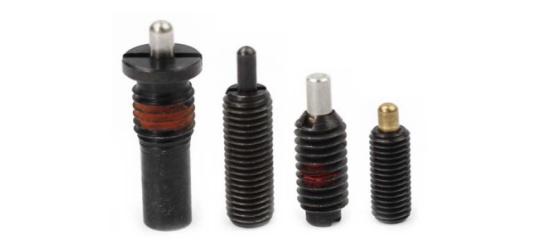
One of the most common applications is creating repeatable positions in rotary plates, turntables, and adjustable fixtures. The plunger pin engages with a series of holes or grooves to produce defined positions.
Typical uses:
indexing tables and rotary fixtures
adjustable guides and stops
machine guards with multiple open positions
conveyor side guide adjustments
Why it helps: Operators can reposition components quickly, and the system returns to the same alignment without measurement each time.
In jigs and fixtures, repeatability is everything. Spring plungers can be used to locate or hold a workpiece, especially when quick changeover is needed.
Typical uses:
modular fixture plates
quick-change nests
clamping position confirmation
poka-yoke style locating aids
Why it helps: You reduce setup time and maintain consistent positioning across batches.
Machines need access doors and covers, but you don’t always want a complex latch mechanism. Spring plungers can act as a simple retention mechanism for light to medium loads.
Typical uses:
electrical enclosure access covers
inspection doors on automation equipment
removable guarding panels
service hatches on machine frames
Why it helps: It provides a secure “closed feel” and prevents accidental opening due to vibration.
Spring plungers can create the familiar “click stop” behavior in levers and adjustable mechanical elements.
Typical uses:
adjustable arms and brackets
manual positioning slides
machine tool accessories
folding components in industrial carts and racks
Why it helps: Detent stops improve usability and reduce the risk of drifting out of position.
In some systems, a spring plunger acts like a simple mechanical sensor: if the part is present, the plunger is compressed; if not, it stays extended. This can also be combined with external switches.
Typical uses:
part presence verification in fixtures
end-of-travel confirmation
mechanical interlocks
assembly verification aids
Why it helps: It adds a layer of mechanical confirmation with minimal electronics.
In vibration environments, components can rattle and shift. Spring plungers can preload a component lightly to reduce chatter.
Typical uses:
guide rails with minor play
accessory mounts on industrial equipment
anti-rattle features in frames and carriers
alignment assistance in sliding mechanisms
Why it helps: Small preload can improve system feel and reduce wear caused by repeated micro-movement.
Application area | What the spring plunger does | Typical benefit |
Indexing plates | engages holes/grooves | repeatable positions |
Fixtures & jigs | locates/retains parts | faster changeover |
Doors & panels | holds closed/open | simple retention |
Levers & slides | creates detent stops | better usability |
Presence sensing | indicates part engagement | error reduction |
Vibration preload | removes looseness | less chatter |
Choosing the right spring plunger is what separates a dependable mechanism from one that fails early in the field. We recommend evaluating the selection in a practical, “real working condition” way—not only by thread size.
Thread size and installation space
Start by confirming the thread standard (metric or inch), thread depth, and the wall thickness of the mounting area. A plunger installed in a thin wall without enough thread engagement can loosen, tilt, or damage the housing over time. Also check whether you have enough clearance for a wrench or hex drive during installation and future replacement.
Spring force and holding requirement
Spring force must match the function. Too much force increases wear on the mating groove/hole and makes manual adjustment difficult. Too little force leads to weak detent action and vibration drift. If possible, test force levels with a sample under real load.
Tip style and contact behavior
Tip choice affects smoothness, surface damage, and repeatability. Ball tips are great for smooth engagement, rounded pins are versatile, flat tips provide stable contact, and nylon/soft tips protect delicate surfaces.
Body and pin material
Stainless steel helps in humid or washdown environments, while hardened pins are important for long-life indexing and frequent cycling.
Environment and duty cycle
Consider coolant exposure, dust/abrasives, outdoor moisture, and shock loads. Harsh conditions often require better sealing, corrosion resistance, and higher wear tolerance to maintain consistent performance.
Spring plungers may be small, but they play a major role in the reliability and usability of machinery and automation systems. From indexing and fixture positioning to cover retention, detent mechanisms, and vibration preload, the most common industrial applications of spring plungers are all about making motion repeatable and equipment easier to operate. The key is selecting the correct spring force, tip type, material, and mounting method for the real working conditions. When specified correctly, a spring plunger can reduce complexity, improve changeover efficiency, and deliver consistent performance over long service life.
To learn more about spring plunger options and selection support, you can visit www.pdmindustry.com. If you’d like help matching a spring plunger to your machine design, load requirement, or environment, you are welcome to contact us with your application details for practical recommendations.
Spring plungers are commonly used for indexing, positioning, detent stops, panel retention, fixture locating, and vibration preload in machinery and automation systems.
Match spring force to your holding requirement and operator usability. Higher force improves retention but increases wear and makes manual adjustments harder.
Ball tips or hardened rounded tips are often preferred for repeated engagement because they reduce friction and provide smoother indexing, but the best choice depends on the mating feature design.
Stainless steel spring plungers are more corrosion resistant and are recommended for humid, washdown, or chemically exposed environments, while hardened pins are important for wear resistance.


