
Views: 0 Author: Site Editor Publish Time: 2026-03-11 Origin: Site
Precision and repeatability are fundamental requirements in modern mechanical systems. In industrial equipment, automation lines, and precision fixtures, components must repeatedly move into exact positions without error. Achieving this level of accuracy often depends on small but critical mechanical parts. One of the most reliable components used for this purpose is Spring Plungers. These compact mechanical devices provide controlled force, repeatable positioning, and simple locking functionality, making them indispensable in many engineering applications.
From machine fixtures and indexing tables to automation equipment and positioning mechanisms, spring plungers are widely used to ensure that parts align precisely and remain securely positioned during operation. While they may appear to be small hardware elements, their impact on mechanical reliability and production efficiency is significant. When integrated correctly into a design, they help prevent misalignment, reduce vibration, and ensure consistent positioning even in high-speed industrial environments.
At our company, we have worked extensively with industrial manufacturers who rely on these components to improve mechanical stability and simplify positioning systems. Understanding how spring plungers function, how they are designed, and how they should be selected can help engineers and designers build more reliable mechanical systems. This guide explores the fundamentals of spring plungers, their role in positioning and indexing, and how they support precision mechanical design.
Spring plungers are mechanical components designed to provide a controlled spring force through a movable plunger or ball. Inside the device, a spring pushes a pin or ball outward, allowing it to engage with a mating surface or positioning hole. When pressure is applied, the plunger retracts and then automatically returns to its original position once the force is removed.
This simple mechanism makes spring plungers ideal for applications where repeatable positioning or indexing is required. They allow moving parts to snap into place without requiring complex locking systems.
The basic structure of a spring plunger includes three key elements:
The threaded body that allows installation into mechanical structures
The internal spring that generates the force
The plunger pin or ball that contacts the positioning surface
Although the design is relatively simple, the engineering precision involved in manufacturing these parts is essential. The spring force, material hardness, and dimensional accuracy all influence the performance of the plunger.
Spring plungers are widely used in industries such as:
Automation equipment
Packaging machinery
CNC machines
Industrial fixtures and jigs
Robotics and assembly systems
Their ability to provide reliable positioning with minimal maintenance makes them a practical solution for many mechanical systems.
Positioning mechanisms are used whenever machine components must move into a defined location and remain stable during operation. Spring plungers are frequently used in these systems because they allow components to lock into place quickly while still enabling easy repositioning.
For example, indexing tables often require components to stop at precise intervals. A spring plunger can engage with pre-drilled holes in the indexing plate, ensuring the table stops exactly at the desired position.
Similarly, adjustable fixtures rely on spring plungers to hold movable components securely. Operators can reposition a part by compressing the plunger, adjusting the fixture, and allowing the plunger to re-engage automatically.
Some key advantages of using spring plungers in positioning systems include:
Reliable and repeatable positioning
Simple mechanical operation
Minimal maintenance requirements
Compact design suitable for tight spaces
Because of these benefits, spring plungers are frequently integrated into equipment where both precision and efficiency are required.
Indexing refers to the process of moving a component to a series of predetermined positions. Many industrial machines rely on indexing mechanisms to ensure accurate alignment during repetitive processes.
Spring plungers play a critical role in indexing systems by acting as positioning stops. When a rotating or sliding component reaches the correct location, the plunger engages with a corresponding notch or hole.
Common indexing applications include:
Rotating tool holders
Machine adjustment mechanisms
Positioning plates
Fixture alignment systems
These mechanisms allow equipment operators to move components quickly while maintaining accurate positioning.
Below is a simplified comparison of how spring plungers function in different indexing scenarios.
Application | Positioning Method | Role of Spring Plunger | Result |
Indexing table | Rotational stops | Engages positioning holes | Precise rotation control |
Adjustable fixture | Sliding adjustment | Locks fixture position | Stable work holding |
Machine guards | Alignment locking | Holds guard in position | Improved safety |
Automation devices | Repeat positioning | Maintains location accuracy | Reliable automation |
This versatility explains why spring plungers are widely used across many industrial designs.
Spring plungers come in several variations designed for different mechanical requirements. Selecting the correct type ensures optimal performance for the intended application.
Ball nose plungers use a hardened steel ball at the tip of the plunger. This design reduces friction and allows smoother movement against surfaces.
They are often used for:
Light indexing applications
Positioning plates
Detent mechanisms
Pin-style plungers use a cylindrical pin instead of a ball. These are commonly used when stronger positioning engagement is required.
Typical uses include:
Machine fixtures
Locking mechanisms
Tool alignment systems
Locking plungers allow the pin to remain retracted until manually released. This type is used in applications where temporary disengagement is necessary.
Examples include:
Adjustable machine components
Industrial equipment adjustments
Safety positioning systems
Each design serves a specific purpose, and engineers must consider both function and operating conditions when selecting the correct plunger type.
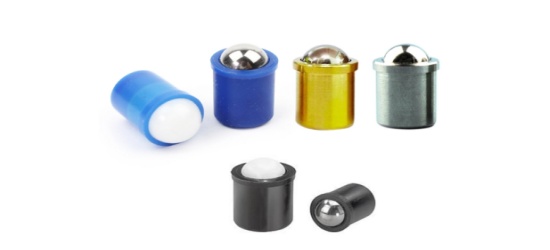
Material selection is crucial in determining the durability and performance of spring plungers. Since these components often operate under repeated stress, their materials must resist wear, corrosion, and mechanical fatigue.
Common materials include:
Stainless steel for corrosion resistance
Carbon steel for high strength applications
Hardened alloy steel for heavy-duty use
Plastic or polymer tips for delicate surfaces
The choice of material depends on factors such as environmental conditions, load requirements, and contact surface compatibility.
Below is a simplified overview of common material options.
Material | Key Advantage | Typical Use |
Stainless steel | Corrosion resistance | Food processing equipment |
Hardened steel | High durability | Heavy machinery |
Alloy steel | High load capacity | Industrial automation |
Plastic tip | Surface protection | Precision instruments |
Selecting the right material helps ensure long-term reliability and consistent positioning performance.
When incorporating spring plungers into a mechanical design, engineers must consider several factors to ensure optimal performance.
The spring force determines how firmly the plunger engages with the mating surface. Too little force may cause positioning instability, while excessive force may increase wear.
Most spring plungers use threaded bodies for easy installation. Proper mounting depth ensures correct engagement and reliable operation.
Machines operating in harsh environments may require corrosion-resistant materials or sealed designs to prevent contamination.
Although spring plungers require minimal maintenance, selecting high-quality components helps extend service life and maintain performance.
By considering these factors during the design phase, engineers can create mechanical systems that remain reliable under demanding conditions.
As automation and precision manufacturing continue to evolve, the importance of reliable positioning components becomes even greater. Spring plungers provide a simple yet highly effective solution for ensuring consistent mechanical alignment.
Compared with more complex locking mechanisms, spring plungers offer several advantages:
Compact design
Low manufacturing cost
Easy installation
High reliability
Because of these characteristics, they are widely used across industries ranging from automotive manufacturing to robotics.
Mechanical designers often favor spring plungers because they allow systems to achieve accurate positioning without adding unnecessary complexity to the design.
Precision positioning is one of the most important aspects of mechanical design, and small components often play a critical role in achieving reliable performance. Spring Plungers provide an effective and efficient solution for positioning and indexing mechanisms in industrial machinery, automation systems, and engineering equipment. Their simple structure, dependable spring force, and wide range of configurations make them a valuable component in modern mechanical systems.
At our company, we have seen how carefully designed mechanical components contribute to more stable equipment operation and improved production efficiency. For engineers and manufacturers seeking reliable positioning solutions, high-quality spring indexing plungers can provide both durability and precision.
If you would like to explore more about spring plungers, positioning solutions, or mechanical components for industrial applications, we welcome you to learn more at www.pdmindustry.com. Our team is always ready to share technical information and support your mechanical design projects.
Spring Plungers are used for positioning, indexing, and locking components in machinery, fixtures, and automation systems.
They provide consistent spring force that allows machine parts to align precisely and return to the same position repeatedly.
Common materials include stainless steel, hardened steel, and alloy steel depending on the required durability and environment.
Ball nose spring plungers are typically used when smoother engagement and reduced


