Views: 0 Author: Site Editor Publish Time: 2026-10-09 Origin: Site
Working as a fluid dynamics and pump engineer for over a decade, I deal with high-speed rotating equipment daily. A loose shaft collar or a slipping impeller gear can destroy a multi-thousand-dollar pump system in seconds. The component preventing this catastrophic failure is the set screw. Commonly known as a grub screw in some regions, this headless fastener threads completely into a hole to lock moving parts securely. How does a tiny piece of metal hold massive industrial assemblies together? Let us dive into the mechanics and practical applications.
Navigating the sheer variety of fasteners available today can overwhelm even seasoned technicians. The purpose of this guide is to break down exactly what these components do, how their underlying mechanics work, and how to select the perfect variation for your specific project. Whether you are commissioning heavy industrial machinery or simply fixing a loose door handle, understanding the nuances of these critical components will save you time, money, and severe operational frustration.
Primary Function: This fastener is predominantly utilized to secure an object—such as a gear, pulley, or collar—against a secondary object like a rotating motor shaft. It achieves this through intense friction and compression rather than relying on a traditional screw head.
Variety of Points: The tip profile dictates its ideal application. An aggressive cup shape is perfect for permanent high-torque holds. A softer tip provides non-destructive clamping.
Installation Matters: Proper installation techniques are absolutely crucial. Applying the correct torque and utilizing thread-locking fluids prevent the fastener from backing out under heavy vibration.
Choosing the Right Fastener: Selecting the appropriate hardware depends heavily on the hardness of the mating shaft and whether the mechanical assembly will require frequent disassembly in the future.
A set screw is a specialized type of threaded hardware designed to hold parts in a fixed position relative to one another. Because of its headless design, it is driven entirely into the material using an internal wrenching drive. Depending on the specific design, a mechanic might use a hexagonal Allen key, a Torx driver, or a simple flathead screwdriver to install it.
In contrast to standard bolts, the mechanics here operate on an entirely different principle. A conventional bolt holds two components together by clamping them between its head and a nut. This headless alternative exerts compressive force directly onto a mating part. Imagine a metal collar sliding over a steel pump shaft. Driving the fastener through the collar until it bites into the shaft locks the two pieces together seamlessly.
The physics behind this secure hold relies heavily on torque. As rotational force is applied to the internal drive, it translates into immense clamping pressure at the tiny point of contact. This focused friction prevents the internal shaft from slipping or rotating independently of the outer housing.
Recent industry analyses reveal a notable shift in the global fastener market toward miniaturization and enhanced vibration resistance. As sectors like aerospace, robotics, and electric vehicle manufacturing continue to expand rapidly, the demand for precision-engineered fastening solutions has surged. Modern engineers are increasingly prioritizing hardware that can withstand harsh dynamic loads without adding unnecessary bulk to the final assembly.
Specifically, these fasteners are heavily relied upon in power transmission systems. Walk into any manufacturing plant, and you will find them locking massive gears, drive pulleys, sprockets, and retaining collars to high-speed rotating shafts. Without them, the rotational energy would simply cause the components to slip. This slippage brings machinery to a grinding halt and causes severe financial losses due to unplanned downtime.
Furthermore, automotive and aerospace engineering heavily utilize these components in high-vibration environments. Engine components, steering columns, and complex aerodynamic actuators require precise low-profile fastening. A protruding bolt head in these tight spaces would cause catastrophic mechanical interference.
The tip profile of the fastener is arguably its most critical feature. It determines how the component interacts with the mating surface. Understanding these variations is essential for making an informed purchasing decision. To make selection easier for your engineering teams, I have compiled a core comparison matrix based on practical field applications.
Point Style | Primary Mechanism | Best Application Scenario | Shaft Marring |
|---|---|---|---|
Cup Point | Cuts into the mating metal | Permanent installation on hard steel shafts | High |
Nylon Tip | Compresses against the surface | Soft shafts, threaded parts, frequent adjustments | None |
Flat Point | Surface friction | Ground flat shafts, frequent resetting | Low |
Cone Point | Wedges into a pre-drilled dimple | Permanent immovable setting | High |
The Cup Point Set Screw is by far the most common configuration found in industrial supply catalogs. Its distinct concave cup shape features a sharp circular edge that physically cuts into the metal of the shaft when tightened. Consequently, it delivers a permanent high-torque grip. Products sourced from PDM Industry feature high-strength alloy steel construction specifically designed for these demanding motor shaft applications. This style is best deployed in fast installations where leaving a slight circular indentation on the shaft is perfectly acceptable.
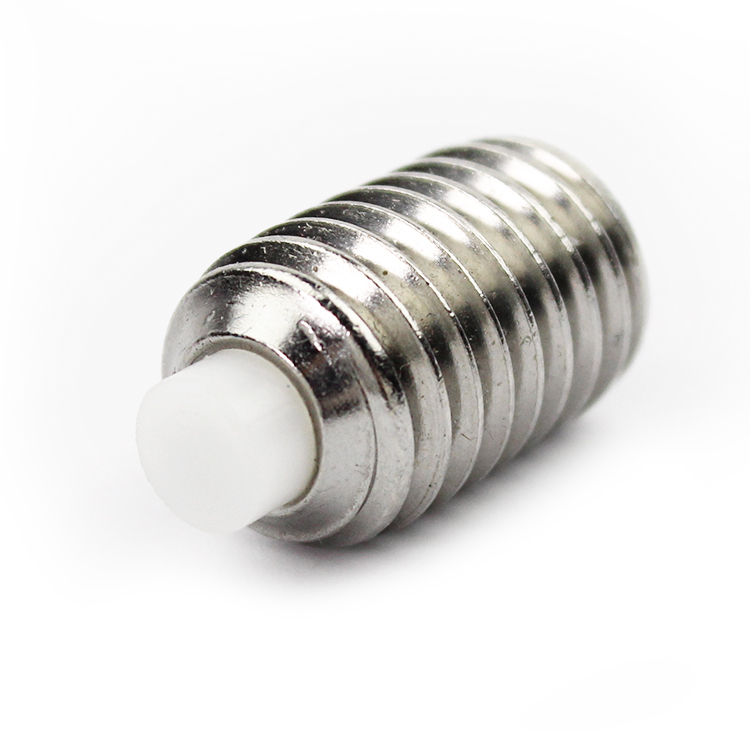
On the other end of the spectrum is the Nylon Tip Set Screw. This innovative design consists of a standard metal body fitted with a soft compressible polymer insert at the very tip. Its primary benefit is non-destructive clamping. When tightened, the soft tip conforms to the shape of the shaft. It grips tightly without scratching or scoring the metal. This makes it the ideal choice for securing soft aluminum shafts, delicate threaded components, or intricate assemblies that require frequent fine-tuning.
When deciding between a Standard Set Screw and a more specialized profile, evaluate the vibration and torque requirements of your specific application. A fundamental rule of thumb in mechanical assembly is assessing shaft hardness. The metal of the fastener must generally be harder than the shaft it is biting into to create a secure hold. High-torque environments demand aggressive profiles to prevent slippage. Delicate setups are much better served by gentle Flat or Nylon profiles.
Even the highest quality hardware will fail if installed incorrectly. Proper installation begins with utilizing the correct tools. Always ensure your hex key or Torx driver is in excellent condition and perfectly sized. Using a worn or slightly undersized tool is the fastest way to strip the internal drive. This turns a simple five-minute job into a frustrating hours-long extraction process.
Applying the right amount of torque is a delicate balancing act. Over-tightening can easily strip the internal threads of the housing or even crack fragile cast-iron pulleys. Conversely, under-tightening inevitably leads to disastrous mechanical slippage. Whenever possible, consult the manufacturer torque specifications and use a calibrated torque wrench. I always tell my maintenance crews to double-check their torque settings before walking away from a newly commissioned pump.
To combat the relentless loosening effects of machinery vibration, applying a liquid threadlocker is highly recommended. A single drop of medium-strength anaerobic adhesive on the threads before installation acts as a microscopic shock absorber. This locks the fastener firmly in place while still allowing for future disassembly.
Sourcing reliable hardware is critical for the longevity of your assemblies. When evaluating potential fastener suppliers, look for companies that provide clear material transparency, rigid quality control, and robust bulk availability. A reputable supplier should readily provide metallurgical data and structural ratings for their products to ensure they meet your engineering standards.
For maintenance teams, small machine shops, or field technicians, purchasing a comprehensive Assortment Set Screw kit is often the most practical choice. Having various lengths and thread pitches on hand minimizes equipment downtime. For large-scale production lines, negotiating bulk orders of highly specialized profiles is far more cost-effective.
Whether you are engineering a new robotic arm, commissioning an industrial fluid pump, or simply repairing equipment, choosing the right hardware dictates the success of your project. We highly recommend evaluating your mechanical requirements and selecting premium products from PDM Industry. Their extensive catalog offers everything from high-strength alloy variants to delicate metric nylon configurations tailored to your exact specifications. Visit https://www.pdmindustry.com to secure the exact hardware you need to keep your machinery running flawlessly.
Mechanically speaking, they are exactly the same thing. The terminology simply changes based on geography. The former is the standard terminology used throughout the United States and Canada. The latter is the colloquial term primarily used in the United Kingdom, Australia, and New Zealand.
Yes, but with certain caveats. A soft-tipped variant can often be loosened and retightened multiple times without issue since the polymer insert simply compresses and rebounds. However, aggressive metal-cutting profiles may lose their sharp biting edge after being torqued down multiple times. This significantly reduces their holding power in subsequent installations.
Because they lack a head, measuring them is quite straightforward. They are measured by their thread diameter and their overall length from end to end. Simply use a pair of digital calipers to measure the outside diameter of the threads and the total physical length of the cylinder.
Chronic loosening is usually the result of three main culprits. These include heavy environmental vibration, improper installation torque, or utilizing the wrong point style for the hardness of the shaft. To permanently fix this issue, ensure you are using the correct tip profile, torque the fastener to specification, and apply a medium-strength liquid threadlocker during installation.
The exact torque requirement depends entirely on the thread size and the material composition of the fastener. A small brass component requires a fraction of the torque compared to a heavy-duty alloy steel variant. Always refer to a standard engineering torque chart specific to the material and thread pitch you are using to avoid stripping the threads.
No, they do not require washers. Washers are designed to distribute the clamping load of a traditional bolt head across a wider surface area. Since these components are headless and thread entirely into a tapped hole to exert internal compressive force, a washer cannot be utilized in their application.