Views: 0 Author: Site Editor Publish Time: 2026-08-12 Origin: Site
Fastener failure in high-torque, space-constrained, or high-vibration environments presents a severe engineering risk. When external wrenching is impossible due to tight housing clearances, selecting the wrong drive type, head profile, or material leads to stripped drives. It causes galvanic corrosion, structural fatigue, and assembly delays on the production floor. You need a reliable method to secure critical components under dynamic loads. This guide provides a technical framework for evaluating internal drive variants. We compare material yield strengths, thread pitches, and dimensional standards. You will learn to match fastener specifications to precise mechanical demands. Engineers rely on internal drives to solve complex clearance issues. Traditional hex bolts require lateral space for heavy wrenches. Internal hex drives eliminate this requirement. You can counterbore them directly into machine housings. This creates flush surfaces and protects the fastener head from lateral shear forces.
Torque-to-Size Ratio: Internal hex drives allow for higher torque transmission in tighter clearances compared to any standard fastener with an external drive.
Profile Dictates Load: Standard socket head cap screws offer maximum tensile strength, while button and flat heads are designed for clearance and sleek aesthetics, sacrificing some load-bearing capacity.
Material Trade-offs: Alloy steel provides superior tensile strength for heavy machinery, whereas a stainless steel hex socket screw is mandatory for chemical or moisture-rich environments despite a lower yield strength.
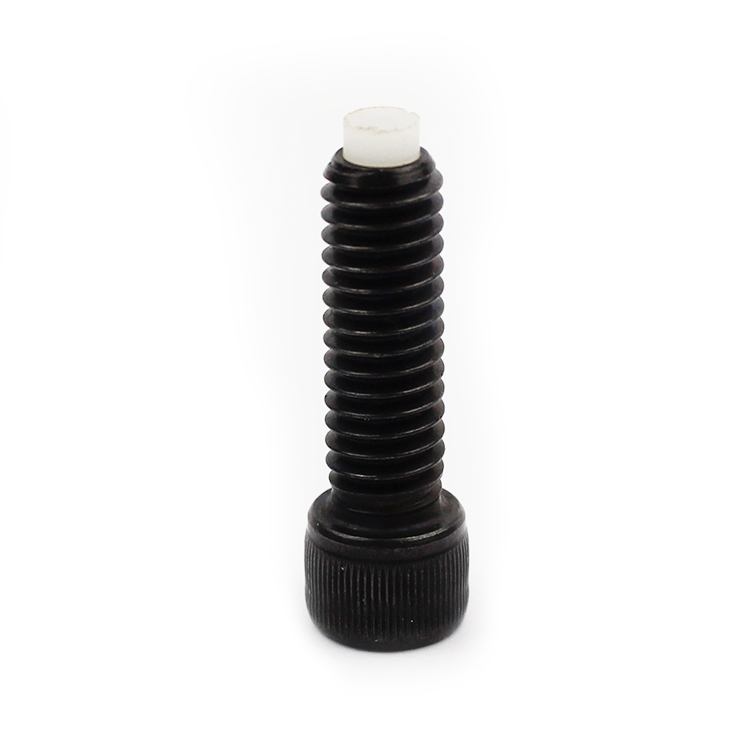
Vibration Mitigation: Specialized variants, such as the nylon tip socket cap screw, provide essential resistance against loosening in dynamic assemblies without permanently marring mating surfaces.
A socket screw features an internal recessed drive forged directly into the head. This is typically a hexagonal or Allen drive. We contrast this directly with externally driven cap screws and standard hex bolts. External drives require bulky tools that grip the outside perimeter of the head. Internal drives accept a precision tool directly into the center axis of the fastener. This fundamental difference changes how you design joint assemblies.
The internal drive eliminates the need for external wrench clearance. You can install these fasteners in highly restricted spaces where a traditional socket simply will not fit. We frequently counterbore them into thick metal plates. This allows the head to sit completely flush or slightly below the surface level. It provides a sleek, low-profile finish for consumer-facing designs and medical devices. Moving machine parts, belts, or pulleys can pass safely over the fastener without interference. This flush mounting also prevents accidental snagging on factory floors.
The hex socket distributes rotational force evenly across six internal flat planes. This specific geometry significantly reduces cam-out risks during high-torque installation. Cam-out occurs when a tool physically slips out of the drive recess due to angular pressure. Phillips or slotted drives suffer from this issue frequently, often damaging the surrounding material. The deep, straight walls of a hex recess keep the tool firmly engaged. You can apply maximum seating torque safely and repeatedly without degrading the drive integrity.
To maximize the mechanical advantage of an internal drive, follow these field-tested installation steps:
Clear the internal recess of any debris, metal shavings, or dirt before inserting the tool.
Select a hardened steel hex bit that matches the exact dimensional tolerance of the drive.
Seat the tool completely into the bottom of the recess to ensure full engagement across all six planes.
Apply rotational force smoothly without jerking the wrench to prevent rounding the internal corners.
Different head profiles serve highly specific mechanical purposes. You must match the head type to the application load and spatial limitations. Using the wrong profile leads to immediate joint failure under heavy dynamic loads.
This profile features a tall, cylindrical head with a flat chamfered top. You will find them extensively in heavy-duty machine assembly, die fixturing, and hydraulic clamping. They dominate industrial applications requiring maximum clamping force.
We use them in stamping dies, plastic injection molds, and high-pressure valve bodies. They offer the highest tensile strength among all socket variants. The thick, robust head accommodates a very deep drive recess. This deep recess allows for massive torque application without stripping. However, they require sufficient vertical clearance. You must counterbore the mating material if a flush finish is strictly necessary. The head diameter is generally 1.5 times the thread diameter. When you need raw holding power, this is the only profile you should specify.
This profile uses an 82-degree (imperial) or 90-degree (metric) conical head. It is specifically designed to sit completely flush with the mating surface.
Engineers use them for aerodynamics, aerospace panels, and moving parts clearance. They are ideal for consumer-facing hardware requiring a perfectly smooth finish. You must perform precise countersinking on the mating material to match the exact angle. They possess a significantly lower torque capacity due to a reduced socket depth. The conical shape physically limits the depth of the hex recess. Do not use them for extreme load-bearing joints. The clamping force relies heavily on the friction of the conical seat. If the countersink angle is off by even one degree, the head will bear uneven loads and snap the shank.
This variant features a low-profile, aesthetically pleasing domed head.
They excel in sheet metal fastening, automotive interiors, and electronic enclosures. Use them where a flush finish isn't possible but snag hazards must be minimized. They offer excellent visual aesthetics. We strictly do not recommend them for high-strength, critical load-bearing applications. The domed head dictates a very shallow drive recess. High installation torque can easily strip the internal hex. They are designed for light clamping and cosmetic covers rather than structural integrity. Treat them as a visual upgrade, not a structural component.
This is a unique headless design. It is fully threaded from end to end and driven entirely below the surface.
You use them to secure pulleys, gears, sprockets, and collars to rotating shafts. They prevent rotational or axial movement between mating components. Point selection dictates the holding power and surface penetration. You must choose the correct point for the shaft material.
Cup Point: The most common type. It cuts a circular ridge into the shaft for maximum holding power under vibration.
Flat Point: Used on flat shafts or against hardened surfaces without causing severe damage.
Cone Point: Penetrates deep into the mating surface. Used for permanent setting or as a pivot point.
Dog Point: Features a protruding flat tip. It fits into a pre-drilled hole or slot in the shaft to act as a permanent dowel pin.
Head Profile | Relative Tensile Strength | Clearance Requirement | Common DIN Standard |
|---|---|---|---|
Socket Head Cap | Highest | High (Counterbore needed) | DIN 912 |
Flat Head (Countersunk) | Moderate | Zero (Flush) | DIN 7991 |
Button Head | Low to Moderate | Low (Surface mount) | ISO 7380 |
Set Screw | N/A (Compression load) | Zero (Internal) | DIN 916 (Cup Point) |
Material dictates exactly how a fastener behaves under extreme stress and environmental exposure. You must balance required tensile strength against necessary corrosion resistance. Specifying the wrong alloy leads to rapid degradation in the field.
Alloy steel delivers maximum tensile and yield strength. It is the absolute standard for heavy machinery and structural joints.
These fasteners handle extreme clamp loads without yielding or stretching. They resist shear forces effectively in dynamic assemblies. A grade 12.9 fastener offers a minimum tensile strength of 1,220 MPa. Alloy steel is highly susceptible to rapid rust and corrosion. You must apply protective finishes like black oxide, zinc plating, or phosphate coatings. Be aware that thick zinc plating may alter thread tolerances, causing binding. Black oxide offers minimal corrosion protection but maintains precise dimensional tolerances for tight fits. I always recommend zinc flake coatings for outdoor structural applications where dimensional stability is required.
Stainless steel offers exceptional, long-term corrosion resistance. It is the mandatory standard for marine, food processing, medical, or chemical applications.
The high chromium content forms an invisible, passive oxide layer. This layer prevents rust even when the surface is scratched or gouged. A4 (316) stainless adds molybdenum for resistance against harsh chlorides and salt water. A stainless steel hex socket screw generally possesses lower tensile strength than high-grade alloy steel. It cannot handle the same extreme clamp loads without stretching. It also carries a significantly higher risk of thread galling during installation. You must account for this lower yield strength when calculating joint tension.
Sometimes standard metals fail to meet specific dynamic or environmental requirements. You have to look at modified or exotic materials to solve complex engineering challenges.
Severe vibration causes standard metal threads to back out. A nylon tip socket cap screw provides excellent self-locking capabilities. The nylon tip physically compresses against the mating shaft. It offers severe vibration resistance without damaging or scoring the shaft surface. You can also specify nylon-patched threads. This involves melting a nylon patch onto the threads for similar prevailing torque locking effects. Aerospace and offshore environments demand extreme materials. Titanium offers high strength and incredibly low weight. Monel provides unmatched resistance to saltwater, hydrofluoric acid, and extreme temperatures.
Procurement errors lead to catastrophic assembly line shutdowns. You must establish strict technical evaluation criteria for all fastener purchases. A slight deviation in thread pitch or head diameter will halt production entirely.
Establish the correct methodology for measuring length. Incorrect measurements cause bottoming out in blind holes or insufficient thread engagement. You measure flat heads by their entire overall length, from the flat top to the tip. You measure cap and button heads from directly under the head to the tip of the threads. Set screws are measured by their total overall length. Always verify thread pitch using a dedicated pitch gauge before installation. Mixing coarse and fine threads will destroy the internal tapping of your machine housing.
Specify exact standards on all engineering drawings and purchase orders. Reference DIN, ISO, or ANSI/ASME standards. This ensures uniform thread pitch, head dimensions, and material grades across global supply chains. For example, DIN 912 specifies standard metric socket head cap screws. ISO 7380 covers button head dimensions. DIN 7991 covers countersunk variants. Strict compliance prevents mismatched hardware.
Specify thread fit classes alongside the dimensional standards. For metric threads, a Class 6g tolerance is standard for external threads. For imperial, a Class 3A fit provides the tight tolerances required for high-strength aerospace and machinery applications. A tighter thread fit significantly improves vibration resistance by reducing lateral movement between the mating threads.
Pair high-strength fasteners with compatible hardware. A grade 12.9 screw requires a similarly graded heavy hex nut. You must use hardened steel washers to distribute the immense load. Soft, standard washers will crush and deform under high clamp loads. This localized crushing causes an immediate loss of joint tension, leading to failure.
Consider thread engagement length during the design phase. To achieve the full tensile strength of the fastener, you need adequate thread engagement. A standard rule of thumb dictates an engagement length of 1.5 times the nominal diameter when threading into steel. When threading into softer materials like aluminum or brass, increase this to 2 or 2.5 times the diameter. This prevents the internal threads from stripping before the fastener reaches its yield point.
Calculate maximum seating torque based on socket depth and material hardness. Button heads strip much faster than tall cap screws. You must calibrate your torque wrenches accordingly for each specific head type. Over-torquing rounds out the internal hex drive, making removal impossible. Under-torquing leads to joint failure under dynamic loads. Always consult a torque-tension chart for your specific material grade.
Engineers must understand the relationship between torque and tension. Use the standard formula T = K x D x P. The K-factor represents the friction coefficient. Applying lubrication or anti-seize drastically lowers the K-factor. If you apply dry torque specifications to a lubricated fastener, you will over-tension and snap the bolt. Always adjust your torque wrench settings based on the surface finish and lubrication state.
Evaluate the required clearance for assembly tools on the factory floor. Consider the physical space needed for L-keys, T-handles, or automated bit drivers on the assembly line. Ensure technicians have a straight line of sight and unimpeded tool access. Ball-end hex keys allow for off-angle driving in tight corners. However, they cannot transmit as much torque as straight bits and are prone to breaking under heavy load.
Even the highest quality hardware fails if installed incorrectly. You must anticipate mechanical risks during the initial design phase. Field failures are rarely due to defective steel. They usually stem from improper installation techniques or poor environmental matching.
Thread galling is highly common when using stainless steel fasteners under heavy load. Friction causes the thread surfaces to fuse together at a microscopic level. The fastener seizes completely and often breaks during removal attempts. I have seen technicians snap heavy bolts simply because they drove them too fast with an impact gun.
Specify anti-seize lubricants containing molybdenum disulfide or PTFE coatings. You can also use dissimilar metal mating. Pairing a stainless steel screw with a brass or bronze nut prevents cold welding entirely. Reduce installation RPMs when using power tools to minimize friction heat. Hand tightening is always preferred for critical stainless joints.
Dynamic loads cause a gradual loss of clamp load over time. Transverse vibration literally shakes the threads loose, compromising structural integrity. Once a joint loses its initial tension, the fastener takes on severe shear loads and snaps.
Evaluate the use of pre-applied threadlockers. Mechanical lock washers offer basic resistance, but chemical locking is superior. Nylon-tipped variants provide excellent prevailing torque and are reusable. Compare these options against the manual application of liquid threadlockers on the assembly line. Pre-applied patches reduce assembly time, ensure consistent application, and eliminate chemical mess on the factory floor.
Worn hex keys damage the internal socket. This rounds out the hex shape, leading to impossible extraction during routine maintenance. A rounded drive turns a five-minute maintenance task into a multi-hour drilling operation.
Implement strict tooling replacement schedules. Do not wait for a bit to fail before replacing it. Specify high-tolerance, hardened steel driver bits. Ensure technicians fully seat the bit into the bottom of the recess before applying any rotational force. Inspect bits weekly for rounded corners or twisting.
While a standard fastener may suffice for basic, static joining, internal drive variants are engineered necessities. They dominate high-torque, low-clearance, and aesthetic-critical assemblies. Precision-aligned machinery relies entirely on their consistent clamping force and low-profile capabilities. Follow a strict decision matrix for selection. Prioritize spatial constraints to determine the correct head type. Calculate the required clamp load to determine necessary drive depth and thread engagement. Assess environmental exposure to finalize your material selection between alloy and stainless options.
Consult technical load tables to verify torque specifications for your chosen head profile.
Request material test reports from suppliers to ensure strict standard compliance.
Implement an anti-seize protocol for all stainless steel installations to prevent thread galling.
Audit your assembly line tooling to ensure hardened bits are replaced before they cause cam-out.
A: A cap screw refers broadly to a fastener designed to clamp components together, often featuring an external hex head. A socket screw specifically features an internal recessed drive, usually a hex. It requires an Allen key or hex bit for installation, allowing for flush mounting and tighter clearance.
A: Measurement depends on the head style. Measure flat heads by their entire overall length, including the head. Measure cap and button heads from directly underneath the head to the flat tip of the threads. Measure set screws by their total overall length.
A: Use stainless steel in environments exposed to moisture, chemicals, or salt water. It prevents rust through a passive oxide layer. Choose alloy steel when maximum tensile strength is required for heavy structural loads, provided the environment is dry or the fastener is heavily coated.
A: Cap screws feature a tall, cylindrical head that accommodates a much deeper internal hex recess. This deep recess provides more surface area for the driver tool. Button heads have a shallow dome, resulting in a shallow recess that strips easily under high torque.
A: It is used in dynamic assemblies subjected to heavy vibration. The nylon tip compresses against the mating surface or shaft. This creates prevailing torque that prevents the fastener from backing out. It also prevents permanent marring or scratching of the mating shaft.
A: Ensure the hex bit is not worn and matches the exact size of the recess. Fully seat the tool into the bottom of the drive before applying rotational force. Do not exceed the maximum recommended seating torque for the specific head profile and material grade.